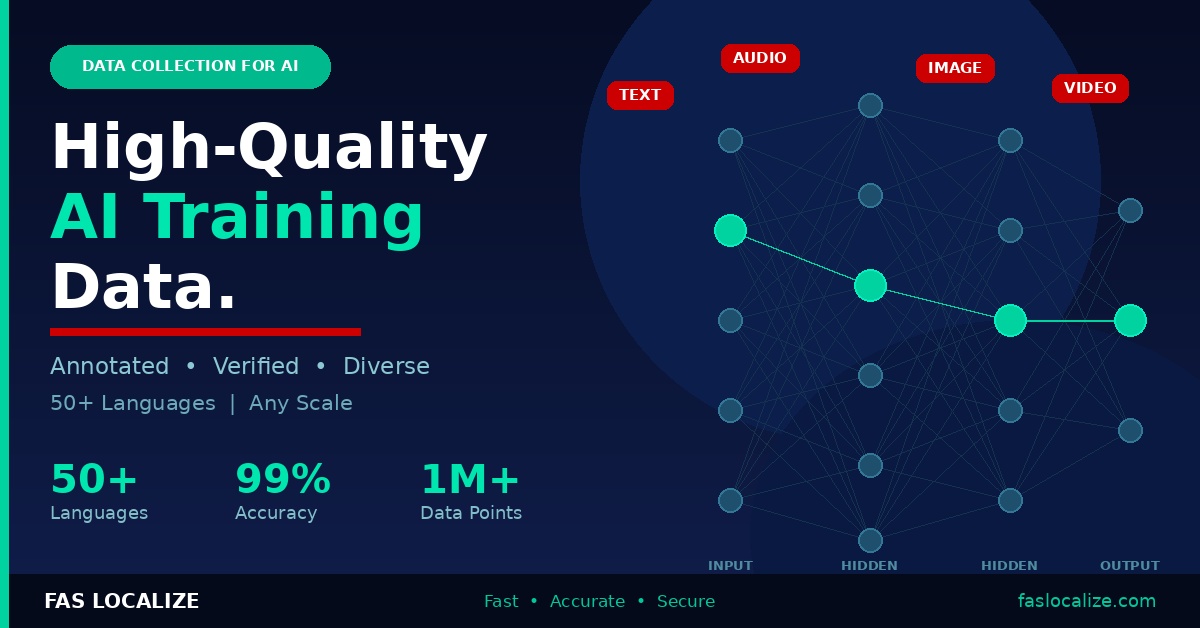
Artificial intelligence is only as smart as the data it learns from. Whether you are building a speech recognition engine, a chatbot, a machine translation tool, or an NLP classifier, the quality, diversity, and accuracy of your training data determine everything.
This is where professional data collection for AI makes all the difference. In this complete guide, we explore what AI data collection involves, why it is mission-critical for modern AI development, and how FAS Localize helps AI teams across the world build smarter, more inclusive models.
What Is Data Collection for AI?
Data collection for AI is the systematic process of gathering, curating, labeling, and preparing raw data — text, audio, images, or video — so that artificial intelligence and machine learning models can learn from it.
Unlike general data collection, AI training data must meet strict requirements: it must be accurately labeled, diverse enough to represent real-world scenarios, free from harmful biases, and formatted in a structure that machine learning pipelines can process.
At FAS Localize, our data collection for AI services covers over 50 languages and specialized domains — delivering datasets that are ready for immediate use in model training and evaluation.
Why High-Quality Data Collection for AI Is Non-Negotiable
Garbage In, Garbage Out
This is the most fundamental rule in AI development. If your training data is noisy, mislabeled, or unrepresentative, your model will reflect those flaws in every prediction it makes. High-quality data collection for AI ensures your model learns from accurate, real-world examples — not errors.
Bias in AI Starts with Biased Data
One of the most cited problems in AI today is algorithmic bias. Models that are trained predominantly on English-language or Western-culture data perform poorly — and sometimes harmfully — for users from other linguistic and cultural backgrounds. Professional data collection for AI actively mitigates bias by ensuring diversity across languages, accents, demographics, and geographies.
Regulatory Compliance Is Becoming Mandatory
As AI regulation expands globally — including the EU AI Act and emerging data governance frameworks in Asia and the Middle East — demonstrating that your model was trained on ethically collected, documented, and auditable data is no longer optional. FAS Localize provides full documentation and compliance support as part of every data collection for an AI project.
Types of Data Collection for AI
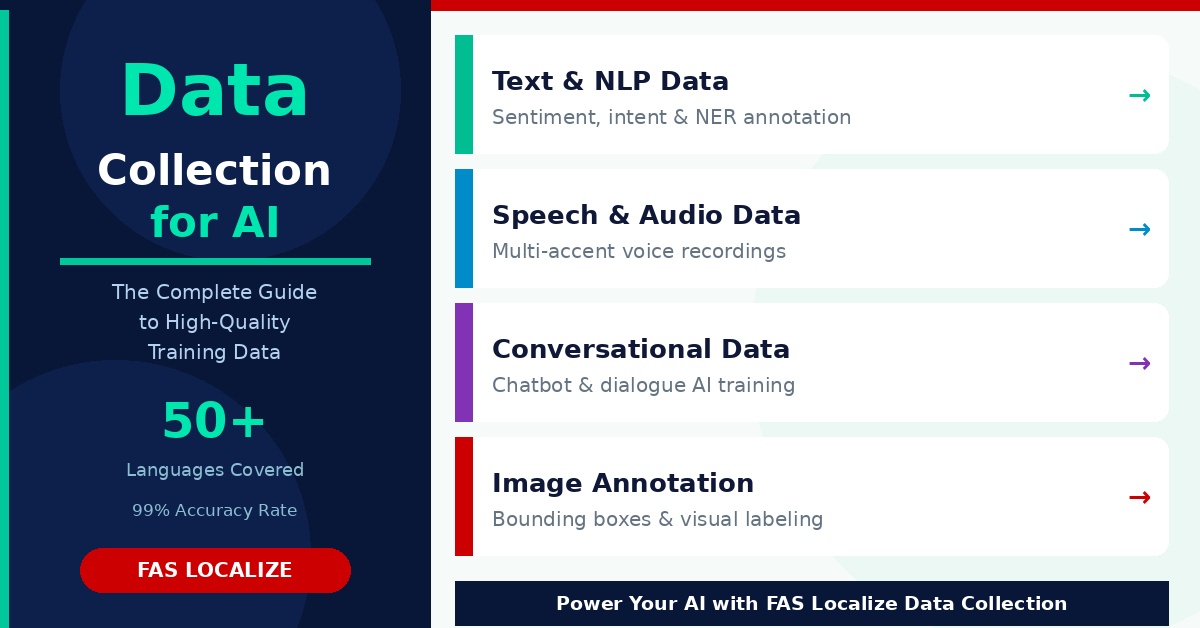
Text and NLP Data Collection
Text is the most common input type for AI models. Our text data collection for AI includes:
- Sentiment-labeled product reviews and social media content
- Intent-classified customer service conversations
- Named Entity Recognition (NER) annotated corpora
- Parallel translation datasets for machine translation models
- Question-answer pairs for information retrieval and search systems
All text data is collected, cleaned, and annotated by native speakers with domain expertise in the target language.
Speech and Audio Data Collection
Speech recognition and text-to-speech models require large volumes of high-quality recorded audio. Our speech data collection for AI captures:
- Studio and naturalistic recordings across accents, ages, and genders
- Read speech, spontaneous speech, and command-and-control data
- Noisy environment recordings for robust ASR model training
- Emotional speech data for sentiment and affect detection models
Conversational and Dialogue Data Collection
Chatbots and virtual assistants require realistic dialogue data that reflects how people actually communicate — including informal language, code-switching, typos, and incomplete sentences. Our conversational data collection for AI captures authentic interactions under controlled, ethical conditions, making your chatbot smarter from day one.
Image and Video Annotation
Computer vision models depend on precisely annotated visual data. Our image and video data collection for AI services includes:
- Bounding box annotation for object detection models
- Semantic and instance segmentation for scene understanding
- Multilingual image labels and captions for vision-language models
- Video frame-level annotation for activity recognition systems
Key Industries That Rely on Data Collection for AI
- Healthcare & Medtech: Clinical NLP, medical imaging AI, and patient communication systems require highly specialized and privacy-compliant training data
- Finance & Banking: Fraud detection, sentiment analysis of financial news, and automated customer service all depend on domain-specific data collection for AI
- E-Commerce & Retail: Product categorization, visual search, and recommendation engines require large-scale annotated product and behavior data
- Automotive & Mobility: Voice command systems and driver monitoring require diverse speech and image datasets across languages and environments
- Legal Tech: Contract analysis and legal document classification AI requires precisely annotated legal text across multiple jurisdictions and languages
The FAS Localize Data Collection for AI Process
At FAS Localize, we have built a global network of qualified native speakers, certified annotators, and domain experts to support AI data projects at any scale. Our data collection for AI follows a rigorous five-stage process:
- Stage 1 — Requirement Analysis: We work with your AI team to define data specifications, annotation schemas, quality benchmarks, and delivery formats
- Stage 2 — Data Collection: We deploy our network of qualified contributors to gather raw data according to your exact requirements
- Stage 3 — Annotation and Labeling: Certified annotators apply labels, tags, and classifications using validated guidelines
- Stage 4 — Quality Assurance: Inter-annotator agreement testing, senior review, and automated validation ensure data meets your quality threshold
- Stage 5 — Delivery: Clean, structured datasets delivered in your preferred format — JSON, CSV, JSONL, XML, or custom schemas
All data collection for AI projects operates under strict Non-Disclosure Agreements, GDPR compliance, and applicable regional data protection regulations.
What Makes FAS Localize Different for Data Collection for AI?
- 50+ Languages: We collect and annotate data in over 50 languages, including low-resource languages often overlooked by other providers
- Domain Expertise: Our annotators have specialized knowledge in healthcare, legal, finance, and technology — not just general language skills
- Scalability: From pilot datasets of 1,000 samples to production datasets of 1 million+ entries, we scale to your project needs
- Speed: Our global contributor network allows parallel collection across time zones — reducing turnaround time significantly
- Transparency: Full annotation guidelines, quality reports, and inter-annotator agreement scores delivered with every project
Conclusion: Better Data Collection for AI Builds Better AI
The AI systems that will define the next decade must work accurately and fairly for users across every language, culture, and context. That starts with better data. Professional data collection for AI is not a cost — it is the investment that determines whether your model succeeds or fails in the real world.
Partner with FAS Localize to power your AI with the high-quality, diverse, and ethically collected training data it deserves. Contact our team today to discuss your data collection for AI requirements and receive a custom project proposal tailored to your model and budget.