In today’s fast-paced global marketplace, the demand for quick, accurate, and affordable translation is higher than ever. Businesses expanding into new markets, e-commerce platforms listing thousands of products, and enterprises managing multilingual content all face the same challenge: how to translate large volumes of text without sacrificing quality or blowing the budget.
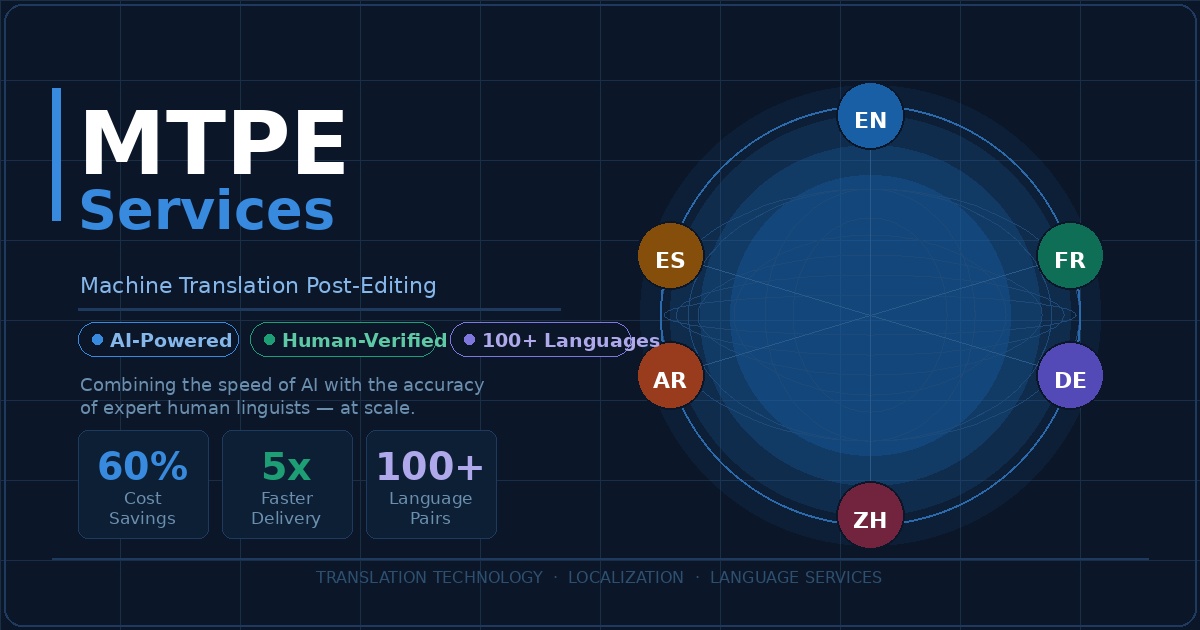
This is exactly where MTPE — Machine Translation Post-Editing services — step in. By combining the speed of AI-powered machine translation with the nuanced judgment of professional human editors, MTPE offers the perfect middle ground between pure automation and fully manual translation.
In this guide, we’ll break down everything you need to know about MTPE services — what they are, how they work, what types are available, and why they might be the ideal translation solution for your business.
What Is MTPE (Machine Translation Post-Editing)?
Machine Translation Post-Editing (MTPE) is a professional translation workflow in which content is first translated automatically using machine translation (MT) engines — such as DeepL, Google Translate, or custom neural MT models — and then reviewed, corrected, and refined by skilled human linguists.
The human post-editor’s role is to ensure that the machine-generated output is:
- Linguistically accurate and grammatically correct
- Culturally appropriate for the target market
- Consistent in terminology and brand voice
- Suitable for its intended purpose and audience
Unlike fully automated machine translation — which is used for quick, informal understanding — MTPE is designed to deliver publication-ready content at a fraction of the time and cost of traditional human translation.
Types of MTPE Services
Not all MTPE is created equal. Depending on your quality requirements and budget, there are two primary types of post-editing:
1. Light Post-Editing (LPE)
Light post-editing focuses on making a machine translation output understandable and usable without performing a thorough linguistic review. Post-editors in this mode will:
- Fix critical errors that affect meaning
- Correct obvious mistranslations
- Ensure the text makes sense for the target audience
2. Full Post-Editing (FPE)
Full post-editing aims to produce a translation that is equivalent in quality to a professionally translated document from scratch. Post-editors will:
- Correct all grammatical, syntactical, and stylistic errors
- Ensure adherence to client style guides and glossaries
- Adapt tone, register, and cultural nuances
- Verify formatting and terminology consistency
Who Needs MTPE Services?
MTPE is ideal for a wide range of industries and use cases:
- E-Commerce & Retail: Localize product listings, descriptions, and customer reviews at scale.
- Legal & Compliance: Translate contracts, policies, and regulatory filings with precision.
- Technology & Software: Localize UI strings, help documentation, and release notes quickly.
- Healthcare & Life Sciences: Translate clinical trial documents, patient information, and medical records.
- Marketing & Advertising: Adapt campaigns, social media content, and landing pages for global audiences.
- Finance & Banking: Handle reports, statements, and compliance documentation across languages.
The MTPE Workflow: Step-by-Step
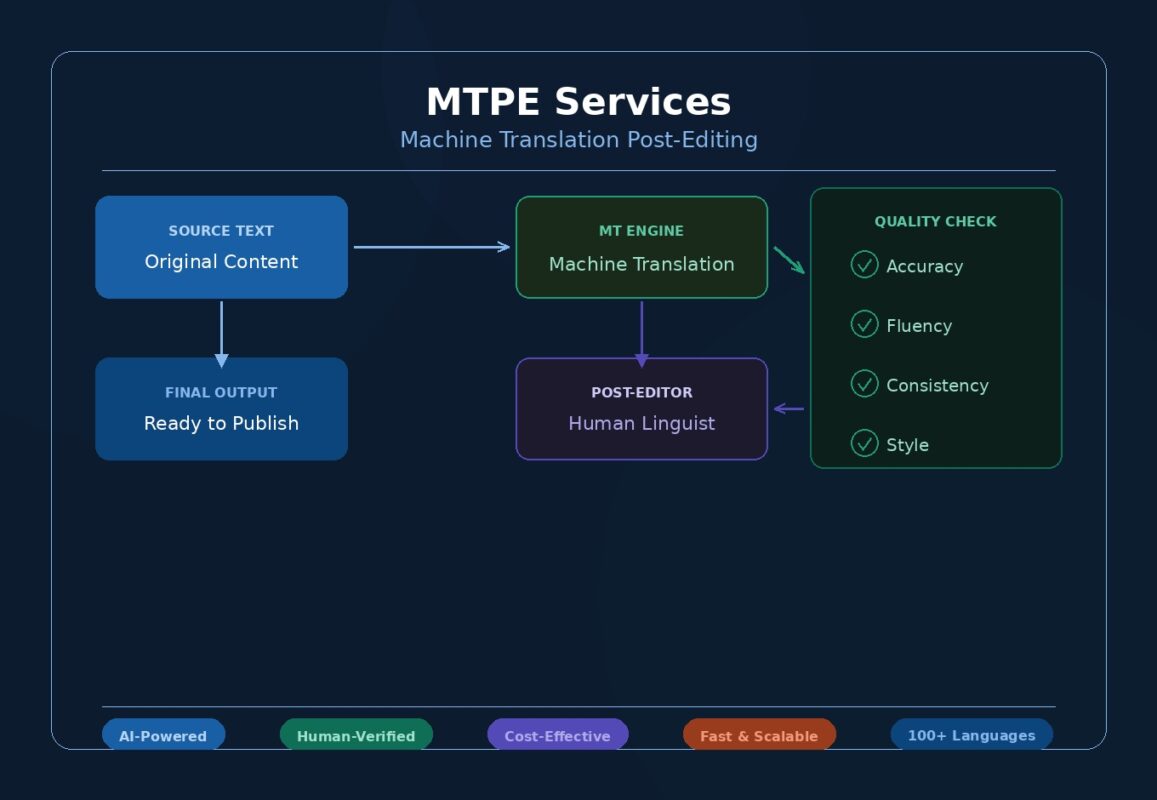
A professional MTPE workflow typically follows these stages:
- Content Analysis & MT Engine Selection: The source content is analyzed for domain, complexity, and volume. The best-fit MT engine is selected.
- Machine Translation: The content is processed by the MT engine to produce a raw translation.
- Post-Editing (Light or Full): Expert linguists review and edit the MT output according to agreed quality levels and style guides.
- Quality Assurance (QA): Automated QA tools and human reviewers verify consistency, terminology, and accuracy.
- Delivery & Feedback Loop: The final translation is delivered, and feedback is used to fine-tune the MT engine for future projects.
How to Choose the Right MTPE Service Provider
Not all MTPE providers are equal. When evaluating an MTPE partner, consider:
- Domain Expertise: Ensure they have linguists experienced in your specific industry.
- MT Engine Quality: Ask which MT engines they use and whether custom engines are available.
- Quality Assurance Process: Look for ISO-certified workflows and multi-stage QA processes.
- Turnaround Times: Confirm they can meet your deadlines without compromising quality.
- Data Security: Verify NDA policies, GDPR compliance, and secure file handling.
- Language Pairs: Check coverage for all your target languages.
- Pricing Model: Understand per-word pricing and whether rates differ for LPE vs. FPE.
Frequently Asked Questions (FAQs)
Q: What does MTPE stand for?
A: MTPE stands for Machine Translation Post-Editing. It refers to the process of using machine translation as a first draft, which is then reviewed and corrected by a human linguist.
Q: Is MTPE suitable for all types of content?
A: MTPE works well for technical, informational, and high-volume content. For highly creative content like poetry, advertising copy, or literary work, traditional human translation or transcreation may be more appropriate.
Q: How much does MTPE cost compared to human translation?
A: MTPE typically costs 30–60% less than traditional human translation, depending on the language pair, content type, and level of post-editing required.
Q: How fast is MTPE?
A: Depending on volume and language pair, MTPE can process several thousand words per day per linguist — often 2–5x faster than traditional translation.
Q: What quality standard does MTPE follow?
A: Most professional MTPE services follow the ASTM F2575 or ISO 18587 standards for post-editing quality.
Conclusion: Is MTPE Right for Your Business?
MTPE services represent the future of scalable, high-quality translation. For businesses managing growing multilingual content needs — from product catalogues and legal documents to software interfaces and marketing materials — MTPE delivers the speed, consistency, and quality that pure machine translation cannot match and that fully human translation cannot afford to maintain at scale.
Whether you need light post-editing for gist-level understanding or full post-editing for publication-ready output, working with a professional MTPE provider ensures that your global content not only reads accurately — it reads naturally.