Language testing has become necessary for education, immigration, and professional certification in a world that is becoming more connected. Organizations need accurate language testing to judge skills, from international tests to corporate assessments, fairly. Vietnamese-language testing is critical because it ensures that Vietnamese-speaking test-takers receive content that is clear, accurate, and culturally appropriate.
If a test is poorly translated, it can cause confusion, wrong answers, and unfair grading. That’s why high-quality Vietnamese translation is not just a need; it’s a must for success around the world.
The Significance of Vietnamese Translation in Language Assessment
Millions of people around the world speak Vietnamese, especially in Vietnam and in Vietnamese communities around the world. As businesses grow in Southeast Asia, the need for Vietnamese language testing keeps rising.
A correct translation makes sure that people taking the test understand the questions, instructions, and context completely. It also helps keep the same test the same in different languages. Even well-designed tests can give bad results if they aren’t translated correctly.
Also, professional Vietnamese translation makes things easier to access and more welcoming. It helps businesses reach more people while keeping their testing systems fair and trustworthy.
Key Components of Language Testing
When translating language tests for Vietnamese, there are many things to consider, not just replacing words with their counterparts in Vietnamese. Each of those areas will need to be attended to at a high level of detail and with a high level of skill.
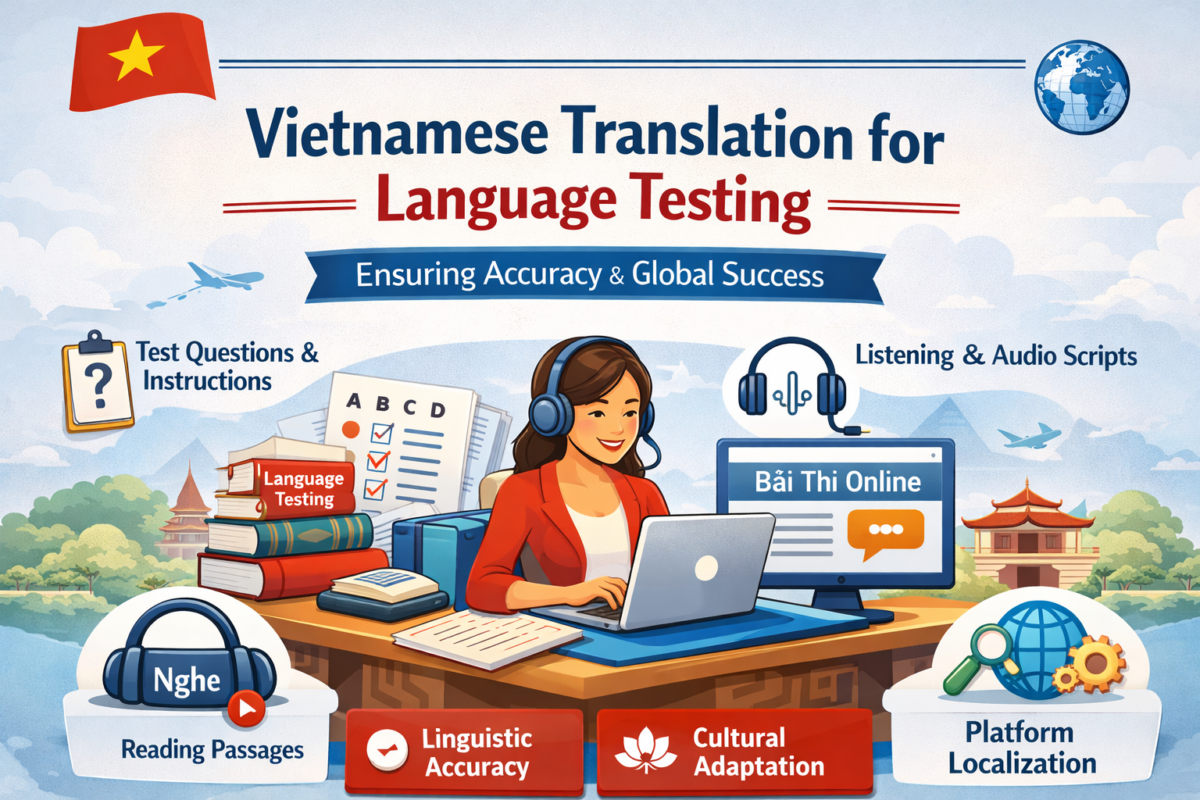
Test Questions And Instructions
At the heart of any language assessment lies the test questions, as well as instructions for those questions. The intent of the question must be maintained as close as possible to what was presented in the source document. A small change in meaning may impact how the student answers the question due to how he/she interprets the intention of the question.
Listening And Audio
A listening test requires both an accurate translation of the listening text as well as an accurate representation of how the listening text sounds when it is read. A native Vietnamese individual should be reading the text so that it sounds clear, natural, and appropriate to the testing context. The reading of the text and how the individual pronounces, intonates, and rates the flow of reading are essential for being able to comprehend the material provided.
Reading and Comprehension Passages
The reading sections for a test will need to be translated so that they provide the same reading and context within the Vietnamese culture, while adapting them to the particulars of the Vietnamese culture. The translator will need to visually adapt complex sentences so that they are interpreted with the same level of difficulty, and yet not be simplified so that they will be represented with a lower level of difficulty.
While localizing the User Interface of an Online Language Test, many aspects should be taken into account, such as Button selections, Instructional items, Menus, and Error messages. When the entire User Interface of an Online Language Test has been localized, it creates a greater User Experience and decreases User confusion while taking the test.
Translating Language Testing materials into Vietnamese is not easy and needs the help of a qualified professional.
Linguistics: The Vietnamese language is a Tonal Language, and therefore, the same word in Vietnamese may have multiple meanings based on the meaning of the tone and usage of the word. In order to accurately translate Language Testing materials from English to Vietnamese, it is essential that the Vietnamese Translator has an in-depth understanding of conversational and tonal linguistics.
Cultural Adaptation
Certain phrases or references in the original test may not resonate with Vietnamese audiences. Localization is necessary to make the content culturally appropriate while preserving its original intent.
Technical and Subject-Specific Content
Many language tests include specialized topics such as medical, legal, or technical content. Translators must have subject-matter expertise to accurately translate complex terminology.
Maintaining Test Integrity
One of the biggest challenges is ensuring that the translated version maintains the same difficulty level and evaluation standards as the original test. This requires a balance between literal translation and contextual adaptation.
Best Practices for High-Quality Vietnamese Translation
To overcome these challenges and ensure high-quality results, organizations should follow proven best practices.
First, always work with native Vietnamese linguists who understand both the language and cultural context. Native experts are better equipped to handle nuances and deliver natural translations.
Second, use glossaries and style guides to maintain consistency across all test materials. This is especially important for large-scale testing projects involving multiple translators.
Third, implement a multi-step quality assurance process. This should include translation, editing, proofreading, and linguistic validation to ensure accuracy at every stage.
Additionally, conducting linguistic quality assurance (LQA) testing helps identify errors and improve overall quality. Real-user testing can also provide valuable insights into how candidates interact with the translated content.
Benefits of Professional Vietnamese Translation Services
Investing in professional Vietnamese translation services offers several long-term benefits for organizations.
It improves the reliability and validity of language tests, ensuring that results accurately reflect a candidate’s abilities. It also enhances user experience by providing clear and easy-to-understand content.
Professional translation helps organizations expand into Vietnamese-speaking markets with confidence. It also ensures compliance with international standards and testing guidelines.
Most importantly, it builds trust among test-takers by providing a fair and transparent evaluation process.
Conclusion
Translating Vietnamese for language testing is a lot more than just a language task. It requires precision, cultural understanding, and technical expertise to deliver accurate and reliable results. From test questions to platform localization, every element must be carefully translated to ensure a seamless experience for Vietnamese-speaking candidates.