Quick AnswerUpdated July 2026
“Localization for new markets directly answers how to ensure your brand resonates authentically with diverse global audiences. It transforms your entire brand experience, language, culture, imagery, and user experience, to feel genuinely native, building trust and removing friction points. This strategic adaptation goes far beyond mere translation, making your product or service feel purpose-built for each local consumer, thereby accelerating market entry and fostering long-term success.”
Expanding into a new international market is one of the biggest opportunities a business can pursue. But entering a new market successfully is not just about having a great product, it is about communicating your value in a way that local audiences can understand, trust, and relate to. This is exactly where localization for new markets becomes a game-changing strategy.
Localization goes far beyond simple translation. It adapts your entire brand experience, language, cultural references, imagery, formats, and user experience, to feel genuinely native to each target market. According to Common Sense Advisory, 75% of consumers prefer to buy products in their native language. For any business serious about international growth, professional localization is not optional, it is essential.
What Is Localization for New Markets?
Localization is the process of adapting every element of your brand communication to align with the specific cultural expectations, language preferences, and regulatory requirements of your target market. While translation only converts words from one language to another, localization transforms the entire experience, making your product or service feel as though it was built specifically for that audience.
This includes adapting date and currency formats, imagery and color choices, tone and formality levels, product features, and legal compliance requirements. When done professionally, localization removes every friction point that stands between your brand and your new market audience.
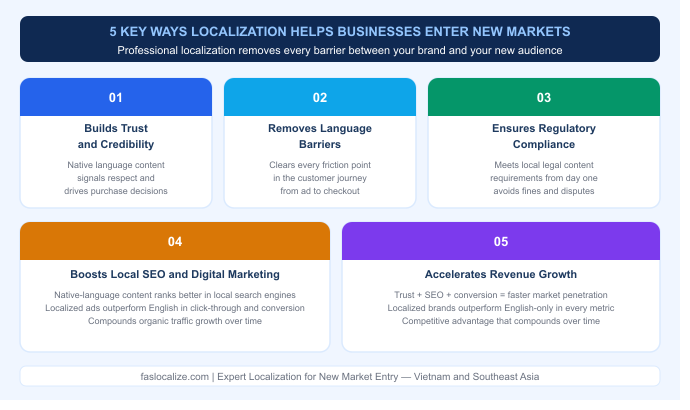
5 Key Ways Localization Helps Businesses Enter New Markets
1. Builds Trust and Credibility With Local Consumers
Trust is the single most important factor in winning customers in a new market. When consumers encounter your website, advertisements, and product content in their own language, with culturally appropriate messaging and locally relevant references, it immediately signals that your brand understands and respects them. This trust accelerates customer acquisition and builds the brand loyalty that sustains long-term market presence.
Brands that enter new markets with poorly translated content or English-only communication immediately signal indifference to local consumers. Professional localization transforms that perception, positioning your brand as committed, respectful, and locally relevant from day one.
2. Removes Language Barriers That Block Customer Acquisition
Language barriers are among the most powerful obstacles to international customer acquisition. When potential customers cannot fully understand your value proposition, product benefits, or purchase process, the customer journey breaks down at the most critical moment. Localization removes these barriers, ensuring every touchpoint, from your first advertisement to your checkout page, is available in natural, native-quality language that requires no effort to understand.
3. Ensures Regulatory Compliance in Local Markets
Most international markets have specific regulatory requirements for business content, including product labeling, privacy policies, terms of service, and customer communications. For example, the Vietnam Ministry of Industry and Trade sets clear requirements for Vietnamese-language product and service information that international businesses must comply with. Professional localization includes regulatory compliance review, ensuring your content meets all local legal requirements from the start and protecting your business from costly compliance failures.
4. Boosts Local SEO and Digital Marketing Performance
Search engines serving local markets strongly favor content that is linguistically and culturally authentic. Professionally localized website content ranks significantly better in local search results than English-language content, driving organic traffic that compounds over time and reduces your customer acquisition costs.
Localized advertising copy consistently outperforms English equivalents in click-through rates and conversion performance, delivering better return on investment across every digital marketing channel, from paid search and social media to email marketing and content marketing.
5. Accelerates Revenue Growth and Market Penetration
Businesses that enter Vietnam and other Southeast Asian markets with professional localization in place from day one consistently outperform those relying on English-only or machine-translated content. The compounding effect of consumer trust, strong local SEO performance, and culturally resonant marketing creates a competitive advantage that significantly accelerates market penetration and revenue growth.
Vietnam: A Market That Demands Expert Localization
Vietnam is one of Southeast Asia’s fastest-growing digital economies, with over 98 million people, a booming e-commerce sector, and a young, tech-savvy consumer base. For international brands, it represents a significant and rapidly expanding opportunity.
However, Vietnamese presents unique localization challenges: it is a tonal language with six distinct tones where a single incorrect tone mark completely changes word meaning, three major regional dialects with significant differences, and a complex social pronoun system that requires careful calibration for each audience segment. Brands that attempt to enter Vietnam without professional localization consistently struggle to build the consumer trust needed to compete effectively with local brands.
- Northern, Central, and Southern Vietnamese dialects require careful dialect selection for each audience
- Six distinct tones make machine translation unreliable without expert human post-editing
- Cultural values around respect, family, and community must shape all marketing messaging
- Vietnamese regulatory requirements apply to product labeling and consumer communications
How FAS Localize Supports Your New Market Entry
At FAS Localize, we specialize in comprehensive localization services for businesses entering new markets across Southeast Asia and beyond. Our certified native-speaking linguists, cultural consultants, and technical specialists, delivering work aligned with Vietnamese government content standards and regional regulatory requirements, ensure every localization project is accurate, culturally authentic, and ready to perform in your target market from day one.
Our market entry localization services include:
- Website and e-commerce localization for new market audiences
- Marketing and advertising content localization and transcreation
- Legal and compliance document translation and certification
- App and software interface localization with full technical testing
- Voiceover and multimedia content localization
- Vietnamese and Southeast Asian market localization specialization
Why Businesses Trust FAS Localize
✓ 99% accuracy rate with rigorous multi-stage linguistic and cultural QA
✓ Native-speaking linguists covering Vietnamese dialects and 230+ languages
✓ Cultural review by market-specific consultants with on-the-ground expertise
✓ MTPE services combining AI speed with expert human post-editing quality
✓ 95% of projects delivered ahead of agreed deadlines
✓ 100% data security compliance and full NDA protection
Final Thoughts
Localization for new markets is not a peripheral activity, it is a core strategic investment that directly determines the speed, cost, and success of your international expansion. Brands that invest in professional, culturally-aware localization from day one build trust faster, acquire customers more efficiently, comply with local regulations, and consistently outperform competitors who enter new markets without proper localization support.
Whether you are entering the Vietnamese market for the first time or scaling across multiple Southeast Asian markets simultaneously, the quality of your localization strategy at the point of market entry will shape your brand’s trajectory in that market for years to come.
Ready to enter new markets with confidence?Contact FAS Localize today and let our expert team help your brand succeed in every market you enter.
Related Articles
Ready to get started?
Tell us about your localization project and get a fast, accurate quote from FAS Localize, usually within one business day.
Get a Free Quote →