Quick AnswerUpdated July 2026
Website localization languages are the specific global languages businesses should translate and adapt their websites into to reach international audiences effectively. Prioritizing languages like English, Mandarin Chinese, Spanish, and Arabic, based on speaker population, internet usage, and purchasing power, enables companies to increase traffic, boost conversions, and build trust in new markets, ultimately driving global growth.
In today’s digital world, having a website in only one language means leaving millions of potential customers on the table. Whether you run an e-commerce store, a SaaS platform, or a service-based business, website localization is the single most powerful step you can take to grow globally.
But which languages should you prioritize? With over 7,000 languages spoken worldwide, the answer isn’t obvious. In this guide, we break down the Top 10 languages you should localize your website into, based on speaker population, internet usage, purchasing power, and global market opportunity.
What Is Website Localization?
Website localization goes beyond simple translation. It means adapting your entire website, content, images, currency, date formats, and cultural nuances, to feel natural and relevant to users in a specific country or region.
When done right, localization can:
- Increase organic traffic from international search engines
- Boost conversion rates in new markets
- Build trust with local audiences
- Improve your overall SEO rankings globally
Top 10 Languages to Localize Your Website
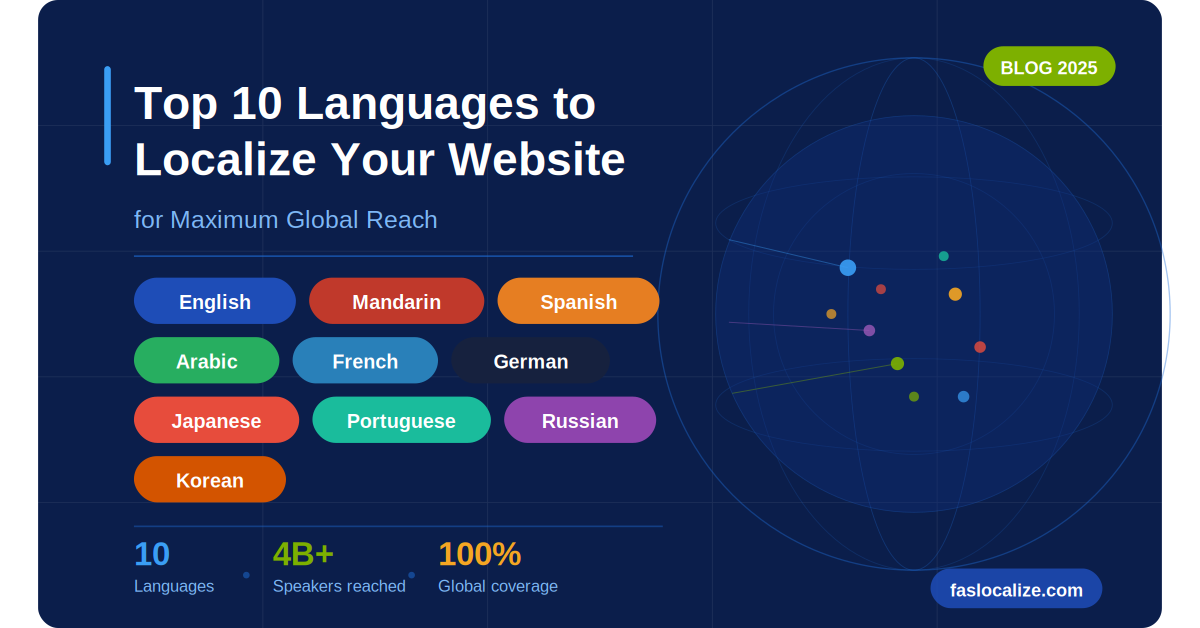
Here are the 10 most strategic languages to prioritize when taking your website global:
Detailed Language Breakdown
1. English, The Global Standard
Even if your website is already in English, make sure it is optimized for different English-speaking regions. American English, British English, and Australian English all have different spellings, phrases, and cultural preferences. This regional optimization alone can significantly boost your search visibility.
2. Mandarin Chinese, The Largest Online Market
China has over 1 billion internet users, the largest in the world. Localizing your website for Chinese audiences requires using Simplified Chinese script, hosting on China-friendly servers, and complying with local regulations. The e-commerce potential is enormous, with platforms like Alibaba and JD.com setting global benchmarks.
3. Spanish, 22 Countries, One Language
Spanish is the official language of 22 countries and is growing rapidly in the United States. From Mexico to Argentina, localizing your website in Spanish opens doors to one of the world’s most dynamic consumer markets. Note that Latin American Spanish differs slightly from Spain Spanish, consider regional variations for best results.
4. Arabic, High-Value, Underserved Market
Arabic is a right-to-left (RTL) language, which means your website layout needs to be mirrored. The Middle East and North Africa (MENA) region represents a high-value market with strong purchasing power, particularly in the Gulf countries like UAE, Saudi Arabia, and Qatar.
5. French, The Language of Culture and Commerce
French is spoken across 5 continents and is the official language of 29 countries. Beyond France, the growing middle class in French-speaking African nations makes this an increasingly valuable language for global businesses. France alone is one of the top 5 e-commerce markets in Europe.
6. German, The B2B Powerhouse
Germany has one of the strongest economies in Europe and a highly educated, tech-savvy population. Studies show that German users are significantly more likely to make a purchase on a website that is in their native language. If you are targeting B2B audiences in Europe, German localization is non-negotiable.
7. Japanese, Premium Spending, Premium Expectations
Japan has one of the highest average online spending rates in the world. Japanese consumers are extremely quality-conscious and have high expectations for localized content. A poorly localized website can seriously damage your brand reputation in this market. Professional Japanese localization is essential.
8. Portuguese, Brazil’s Booming Digital Economy
Brazil is not only the largest country in South America but also one of the fastest-growing digital markets globally. With a population of 215 million and rising internet penetration, localizing for Brazilian Portuguese is an investment with strong ROI. Note: Brazilian and European Portuguese are different, always specify which variant you need.
9. Russian, Reach Eastern Europe and Beyond
Russian is the most spoken language in Europe by number of speakers and is widely understood across 15+ countries in Eastern Europe and Central Asia. Russia has a massive online shopping market, and many neighboring countries use Russian as a secondary language, multiplying your reach.
10. Korean, The Cultural Wave
Driven by the global rise of K-pop, Korean cinema, and Korean skincare trends, the Korean language has gained unprecedented global influence. South Korea also has one of the world’s highest internet penetration rates and a tech-savvy population that engages deeply with online content and e-commerce.

How to Decide Which Languages to Prioritize First
You don’t need to localize into all 10 languages at once. Here is a simple framework to decide where to start:
Check your current Google Analytics, which countries are already sending you traffic?
Look at your competitor websites, which languages do they support?
Evaluate purchasing power, some markets are smaller but spend significantly more per user.
Consider your industry, tech, fashion, and finance have different dominant markets.
Start with 2-3 languages and scale from there based on ROI.
Why Choose FAS Localize for Your Website Localization?
At FAS Localize, we combine AI speed with human expertise to deliver accurate, culturally sensitive, and SEO-optimized website localization services in all 10 of these languages, and many more.
Our services include:
- Professional website translation in 100+ languages
- SEO-optimized multilingual content writing
- Localization testing to ensure everything works perfectly
- Voiceover services for video content
- Data collection and AI language services
Whether you are a startup looking to expand into one new market or an enterprise going global across 20 countries, FAS Localize has the expertise and capacity to support your growth.
Conclusion
Website localization is no longer optional for businesses with global ambitions. By strategically localizing into these top 10 languages, you open your brand to billions of potential customers, dramatically improve your search engine rankings in international markets, and build lasting trust with local audiences.
The question is not whether to localize, it is which language to start with. Ready to take the first step?
Related Articles
Ready to get started?
Tell us about your localization project and get a fast, accurate quote from FAS Localize, usually within one business day.
Get a Free Quote →