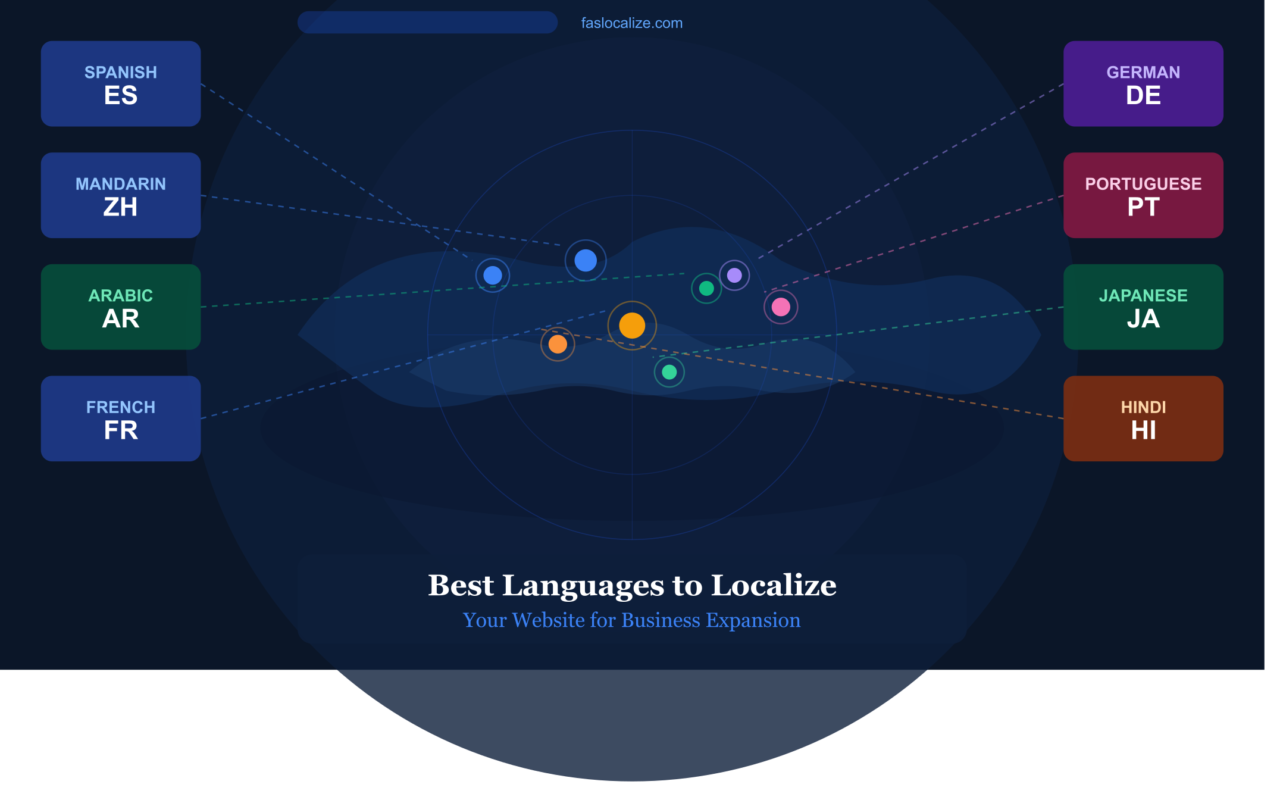
If you want to grow your business beyond borders, website localization is not optional, it is a strategic imperative. But with thousands of languages spoken around the world, which ones should you prioritize? Choosing the best languages to localize your website can determine whether your global expansion succeeds or stalls.
At FasLocalize, we help businesses of every size identify the right target languages and deliver high-quality localized websites that drive real results. In this guide, we break down the top languages for website localization based on market size, internet usage, economic opportunity, and ROI potential.
Why Website Localization Is Essential for Business Growth
Research consistently shows that consumers are significantly more likely to purchase from a website in their own language. According to Common Sense Advisory, 75% of internet users prefer to buy products in their native language, and 60% rarely or never buy from English-only websites.
Website localization goes far beyond simple translation. It involves adapting your content, design, currency formats, images, and user experience to resonate authentically with your target audience in each market. Done right, it dramatically increases conversion rates, customer trust, and brand credibility.
With that foundation in place, let’s look at the best languages to localize your website for maximum business expansion.
The Best Languages to Localize Your Website
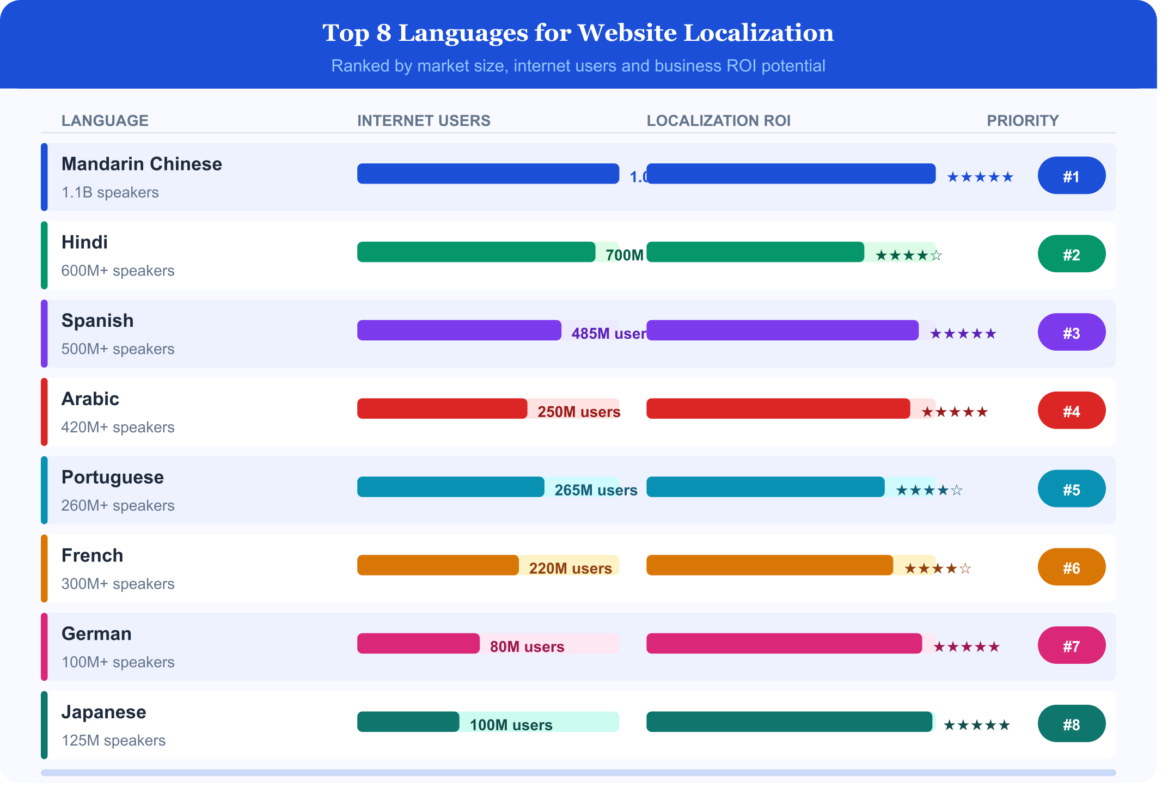
1. Spanish, 500+ Million Speakers
Spanish is the second most spoken language in the world by native speakers and is the dominant language across Latin America and Spain. With a combined GDP of over $6 trillion across Spanish-speaking countries, this is one of the highest-ROI localization targets available.
Key markets include Mexico, Colombia, Argentina, Chile, and Spain. For US-based businesses, the domestic Spanish-speaking market alone represents over 41 million native speakers, making Spanish localization valuable even without leaving your home country.
✓ Covers 20+ countries with a single language
✓ Fast-growing e-commerce markets in Mexico and Colombia
✓ High purchasing power in Spain and Chile
✓ Strong demand for SaaS, retail, and financial services content
2. Mandarin Chinese, 1.1 Billion Speakers
Mandarin Chinese is the most spoken language in the world by total speakers, and China represents one of the largest consumer markets on earth. With over 1 billion internet users and the world’s second-largest economy, localizing your website into Simplified Chinese can open doors to extraordinary growth.
It is important to note that Chinese localization requires more than translation, it involves adapting to local platforms (Baidu SEO instead of Google), payment systems (WeChat Pay, Alipay), and cultural expectations. FasLocalize’s localization specialists ensure your website meets these nuanced requirements.
✓ Largest internet user base globally
✓ Rapidly expanding middle class with high disposable income
✓ Critical for technology, luxury goods, education, and manufacturing
✓ Requires Simplified Chinese for mainland China, Traditional for Taiwan/HK
3. Arabic, 400+ Million Speakers
Arabic is the official language of 22 countries and is spoken by over 420 million people across the Middle East and North Africa (MENA region). The MENA digital economy is growing rapidly, with e-commerce, fintech, and SaaS sectors expanding at double-digit rates year-over-year.
Arabic localization requires right-to-left (RTL) text layout, which has significant implications for website design and development. Businesses that invest in proper Arabic localization, not just translated text but fully RTL-adapted interfaces, see substantially higher engagement and conversion rates in this region.
✓ MENA e-commerce projected to exceed $50 billion by 2025
✓ High smartphone penetration driving mobile commerce
✓ RTL layout adaptation required, not just text translation
✓ Saudi Arabia and the UAE are the highest-value individual markets
4. French, 300+ Million Speakers
French is an official language in 29 countries across Europe, Africa, North America, and the Caribbean. France itself is the 7th largest economy in the world, and French-speaking sub-Saharan Africa represents one of the fastest-growing emerging markets globally.
For businesses targeting Europe, French localization is often prioritized alongside German and Spanish. Additionally, French-speaking Canada (particularly Quebec) offers a large, affluent market that legally requires French-language websites for many product categories.
✓ Official language in 5 continents
✓ French Africa: young, rapidly growing digital consumer base
✓ Quebec market: legal requirements for French content
✓ High purchasing power in France, Belgium, and Switzerland
5. German, 100+ Million Speakers
Germany is the largest economy in Europe and the 4th largest in the world. German speakers across Germany, Austria, and Switzerland (the DACH region) represent a premium consumer segment with high purchasing power and strong demand for quality, accurate product information.
German consumers are particularly sensitive to translation quality. Poor or machine-only translations can severely damage trust and conversion rates in this market. Professional localization with native German speakers is essential for success.
✓ Highest GDP in Europe
✓ DACH region: Germany + Austria + Switzerland combined
✓ Very high standards for translation accuracy and quality
✓ Critical for B2B technology, automotive, engineering, and finance sectors
6. Portuguese, 260+ Million Speakers
Portuguese is the official language of Brazil, the largest country in Latin America and one of the world’s top 10 economies by GDP. Brazil’s e-commerce market is the largest in Latin America and continues to grow rapidly, driven by increasing smartphone penetration and a young, digitally active population.
Note that Brazilian Portuguese and European Portuguese have significant differences in vocabulary, grammar, and tone. FasLocalize recommends separate localization for Brazilian (pt-BR) and European (pt-PT) markets for best results.
✓ Brazil: 8th largest economy globally
✓ Fastest-growing e-commerce market in Latin America
✓ Brazilian Portuguese differs significantly from European Portuguese
✓ Strong demand across retail, entertainment, and fintech
7. Japanese, 125 Million Speakers
Japan may have a smaller speaker base than other languages on this list, but it consistently ranks among the top-performing localization markets for ROI. Japanese consumers have among the highest average online spending per capita in the world and demonstrate strong brand loyalty once trust is established.
Japanese localization requires deep cultural adaptation. Directness common in English marketing copy often does not translate well to Japanese cultural expectations. High-context communication, appropriate formality levels, and culturally relevant visuals are all critical components of successful Japanese localization.
✓ 3rd largest economy in the world
✓ Highest average e-commerce spending per capita in Asia
✓ Strong markets for technology, luxury, cosmetics, and gaming
✓ Requires three writing systems: Hiragana, Katakana, and Kanji
8. Hindi, 600+ Million Speakers
India is one of the world’s fastest-growing digital markets, with over 700 million internet users and a rapidly expanding middle class. While English has significant penetration in urban India, Hindi localization dramatically expands reach to tier-2 and tier-3 cities where the next wave of digital consumers is emerging.
The Indian digital economy is projected to reach $1 trillion by 2030, making Hindi localization an increasingly important strategic priority, particularly for businesses in e-commerce, EdTech, FinTech, and healthcare.
✓ India: 5th largest economy, growing to 3rd by 2030
✓ 700M+ internet users, second only to China
✓ Hindi expands reach beyond English-speaking urban markets
✓ Critical growth sectors: EdTech, FinTech, healthcare, FMCG
How to Prioritize Languages for Your Website Localization Strategy
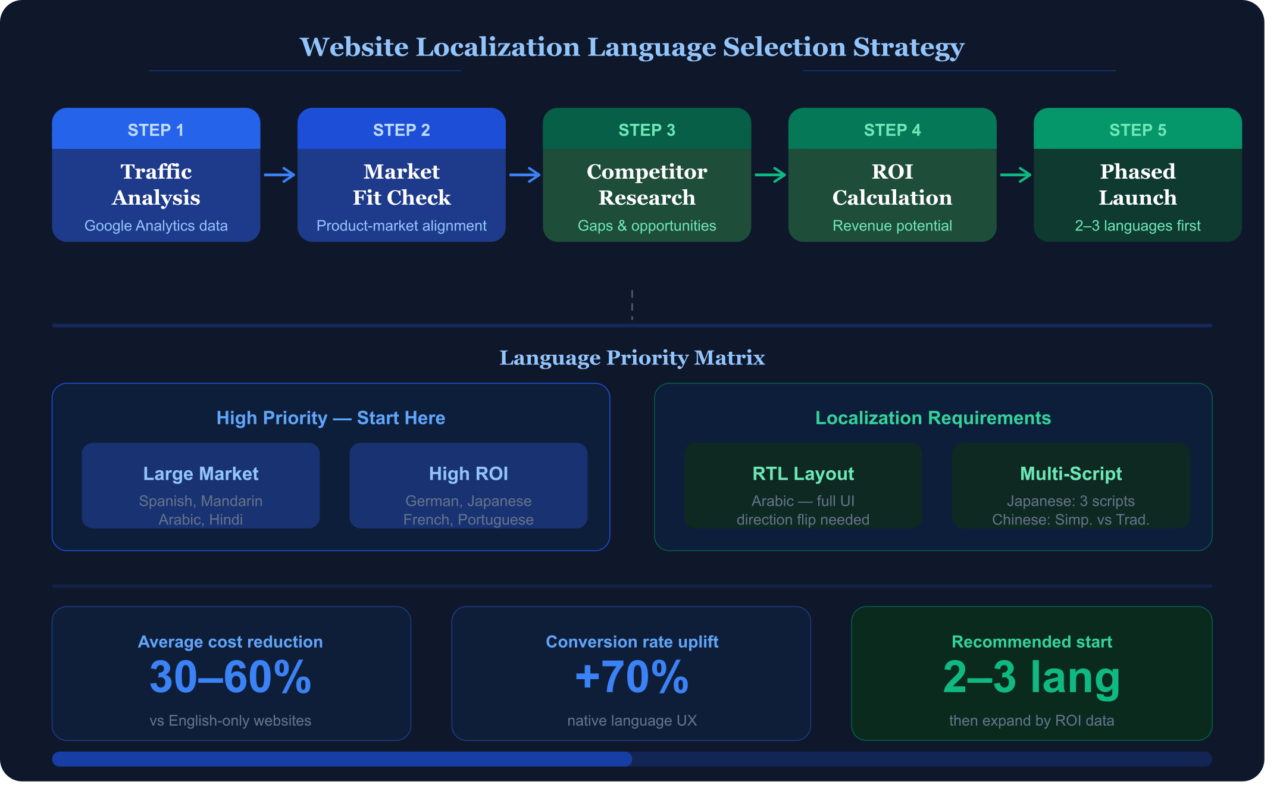
Not every business needs to localize into all eight languages above simultaneously. A strategic, phased approach typically delivers the best ROI. Here is how FasLocalize helps clients build their language prioritization roadmap:
Analyze Your Existing Traffic: Where is your current web traffic coming from? Google Analytics can reveal untapped audiences already visiting your site in languages you do not yet support.
Identify Your Target Markets: Which geographic markets align with your product-market fit? Prioritize languages spoken in regions where your offering solves a genuine problem.
Assess Competitive Landscape: Are your competitors localized in specific markets? If so, localization may be table stakes. If not, localization could be a significant competitive differentiator.
Calculate Market Opportunity: Weigh the market size, e-commerce penetration, and your sector’s growth rate in each target region to estimate potential revenue uplift.
Start with Two to Three Languages: Most businesses see the best ROI by focusing on two to three high-priority languages initially, then expanding based on performance data.
Common Website Localization Mistakes to Avoid
✓ Using machine translation without professional post-editing, damages brand credibility
✓ Translating text only, ignoring RTL layout, date formats, and currency
✓ Using the same content for all Spanish-speaking markets, regional differences matter
✓ Neglecting local SEO, translated pages need localized keywords, not just translated English keywords
✓ Forgetting to localize images, CTAs, and metadata alongside body copy
Frequently Asked Questions (FAQ)
How many languages should I localize my website into?
It depends on your target markets and budget. Most growing businesses start with two to three high-priority languages and expand based on traffic and revenue data. FasLocalize recommends starting with the languages spoken in your top untapped traffic sources.
How much does website localization cost?
Website localization costs vary based on the number of languages, word count, content complexity, and whether you require full translation, MTPE, or cultural consulting. FasLocalize offers scalable pricing models to suit businesses at every stage of growth. Contact us for a custom quote.
What is the difference between translation and localization?
Translation converts text from one language to another. Localization is a broader process that adapts your entire website, including content, images, layout, currency, date formats, and cultural references, to feel native to your target audience. Localization always produces better results than translation alone.
Does FasLocalize support local SEO as part of website localization?
Yes. FasLocalize’s website localization services include local SEO optimization, ensuring that localized pages are indexed correctly, hreflang tags are implemented, and keywords are researched natively in each target language rather than translated from English.
Conclusion
Localizing your website into the right languages is one of the highest-ROI investments a growing business can make. Spanish, Mandarin Chinese, Arabic, French, German, Portuguese, Japanese, and Hindi represent the most strategically valuable localization targets for businesses seeking global expansion.
The key is not to localize into every language at once, but to identify the markets most aligned with your product and business goals, then deliver a localized experience that genuinely resonates with those audiences.
FasLocalize is your trusted partner for professional website localization in 100+ languages. From strategic language selection through final delivery, our expert team ensures your global expansion is built on a foundation of quality, accuracy, and cultural authenticity.
Related Articles
Ready to get started?
Tell us about your localization project and get a fast, accurate quote from FAS Localize, usually within one business day.
Get a Free Quote →