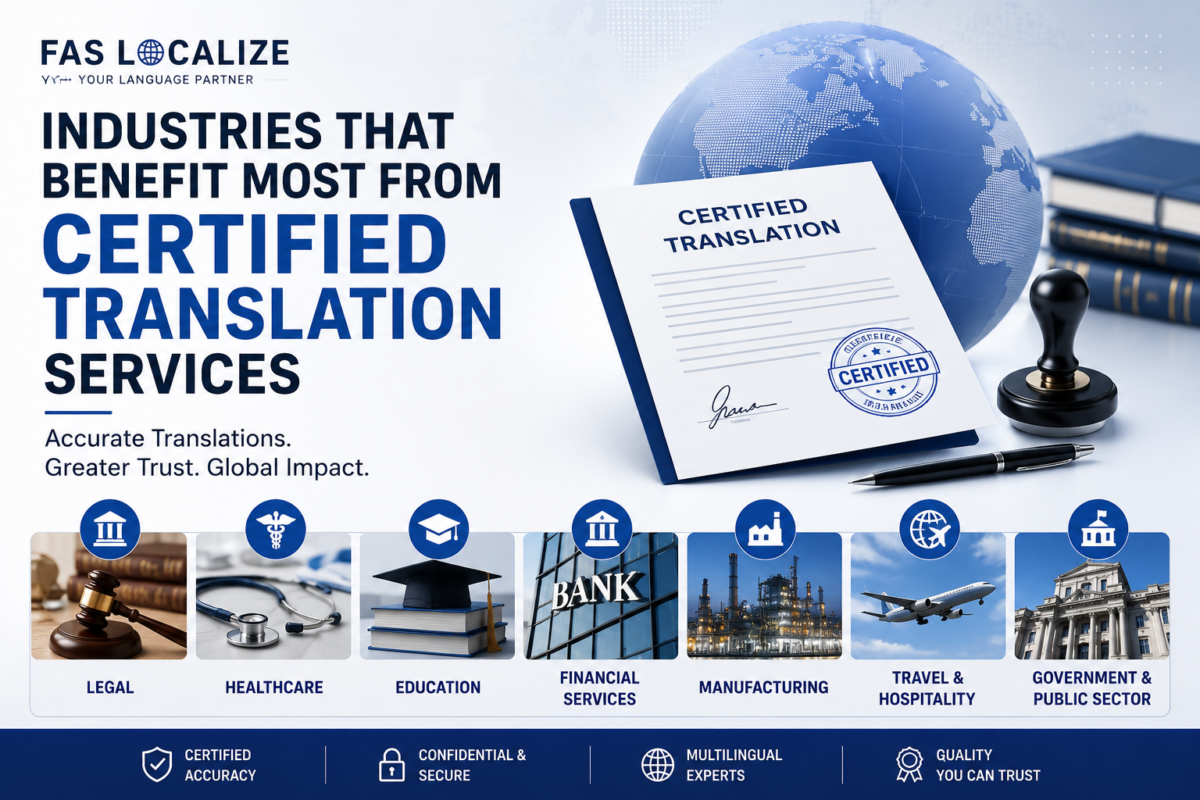
In today’s globalized world, businesses and organizations frequently communicate across multiple languages and regions. Certified translation services play a vital role in ensuring that important documents are translated accurately, professionally, and in compliance with legal requirements. Whether it is a legal contract, medical record, financial report, or academic transcript, certified translations help organizations avoid misunderstandings and maintain credibility.
As international business continues to grow, the demand for certified translation services has increased across many industries. Let’s explore the sectors that benefit the most from these services and why accurate translations are essential for their success.
What Are Certified Translation Services?
Certified translation services refer to translations accompanied by a signed statement from the translator or translation agency, confirming that the translation is accurate and complete to the best of their knowledge. Unlike standard translation, certified translations are required for official, legal, or regulatory purposes.
These translations are accepted by government agencies, courts, academic institutions, and medical authorities worldwide. FAS Localize provides professionally certified translation services that meet international compliance standards across all major industries.
1. Legal Industry: Where Every Word Has Legal Weight
The legal industry is one of the biggest beneficiaries of certified translation services. Courts, law firms, immigration attorneys, and government agencies all require certified translations for a wide variety of documents, including:
- Contracts and agreements
- Court orders and judgments
- Immigration documents and visas
- Birth, marriage, and death certificates
- Power of attorney documents
Any errors in legal translations can lead to case dismissals, contract disputes, or immigration rejections. The demand for certified translation services in law is not just high, it’s mandatory for cross-border legal proceedings.
2. Healthcare and Medical Sector: Life-or-Death Accuracy
Medical translation errors can be fatal. Hospitals, pharmaceutical companies, clinical research organizations, and health insurance providers rely heavily on certified translation services to ensure patient safety and regulatory compliance.
Key documents requiring certified medical translations include:
- Patient medical records and discharge summaries
- Informed consent forms
- Drug labels and pharmaceutical inserts
- Clinical trial documentation
- Medical device manuals and instructions
Regulatory bodies like the FDA in the United States and the EMA in Europe often require certified translations of clinical documents before approving new drugs or medical devices for market entry.
3. Immigration and Government: Compliance Is Non-Negotiable
Immigration authorities in countries like the United States, Canada, the UK, and Australia specifically require certified translation services for all foreign-language documents submitted with visa or residency applications. Without a certified translation, your application can be delayed or denied outright.
Government agencies frequently require certified translations for:
- Passport and national ID translations
- Educational certificates and transcripts
- Police clearance certificates
- Financial statements for visa applications
- Employment verification documents
FAS Localize specializes in certified translation services for immigration purposes, ensuring full compliance with the requirements of USCIS, UKVI, and other major immigration authorities.
4. Finance and Banking: Regulatory Precision at Scale
The financial sector operates under strict international regulations. Banks, investment firms, insurance companies, and fintech startups operating across borders must ensure that all regulatory filings, financial reports, and client-facing documents meet the legal requirements of each jurisdiction.
Certified translations are commonly needed for:
- Annual reports and financial statements
- Loan agreements and mortgage documents
- Anti-money laundering (AML) compliance documents
- Insurance policies and claims
- Regulatory filings and audit reports
For multinational banks and financial institutions, working with a trusted provider of certified translation services is essential to maintain regulatory compliance and build trust with international clients and stakeholders.

5. Education and Academic Institutions: Enabling Global Mobility
As international student enrollment continues to rise globally, universities, colleges, and credential evaluation agencies are among the top users of certified translation services. Academic institutions require certified translations for:
- University diplomas and degree certificates
- Academic transcripts and grade records
- Letters of recommendation
- Research papers and theses
- Scholarship and exchange program applications
Organizations like WES (World Education Services) and NACES members specifically require certified translation services to evaluate foreign credentials for students applying to North American institutions.
6. Pharmaceutical and Life Sciences: Meeting Global Regulatory Standards
Beyond the medical sector, pharmaceutical companies have unique, complex needs when it comes to certified translation services. Bringing a new drug to market in multiple countries requires an enormous amount of translated documentation that must meet the precise standards of each country’s health authority.
Typical pharmaceutical translation requirements include:
- Regulatory submission dossiers (eCTD format)
- Summary of Product Characteristics (SmPC)
- Patient Information Leaflets (PILs)
- Pharmacovigilance reports
- Good Clinical Practice (GCP) documentation
Certified translation services in this field require specialized translators with deep knowledge of pharmacology, chemistry, and regulatory affairs, which is exactly what FAS Localize delivers.
7. E-Commerce and Retail: Reaching Global Customers Compliantly
Global e-commerce brands expanding into new markets often overlook the legal side of translation. However, certified translations are required for product compliance documentation, import/export permits, and consumer protection disclosures in many countries.
From customs declarations to product safety certificates, certified translation services help e-commerce businesses avoid costly legal complications while building trust with international customers.
Why Choose FAS Localize for Certified Translation Services?
At FAS Localize, we understand that certified translation services are about more than just converting text from one language to another. They are about accuracy, compliance, and trust, especially in high-stakes industries. Our team of certified, native-speaking translators delivers:
- ISO-compliant certified translations accepted worldwide
- Industry-specialized translators with subject matter expertise
- Fast turnaround without compromising quality
- Support for 100+ language pairs
- Transparent certification statements and notarization when required
Whether you need certified translations for legal proceedings, medical records, immigration files, or financial documents, FAS Localize is your trusted partner for professional certified translation services.
Conclusion: Certified Translations Are Industry Essentials
Certified translation services are no longer a niche requirement, they are a fundamental business necessity across legal, medical, financial, educational, and government sectors. As global commerce and international mobility continue to grow, the demand for accurate, officially recognized translations will only increase.
If your business or personal needs fall within any of the industries discussed above, don’t risk costly mistakes with uncertified translations. Contact FAS Localize today to get professional, compliant, and fast certified translation services tailored to your industry’s requirements.
Related Articles
Ready to get started?
Tell us about your fas localize services project and get a fast, accurate quote from FAS Localize, usually within one business day.
Get a Free Quote →