Quick AnswerUpdated July 2026
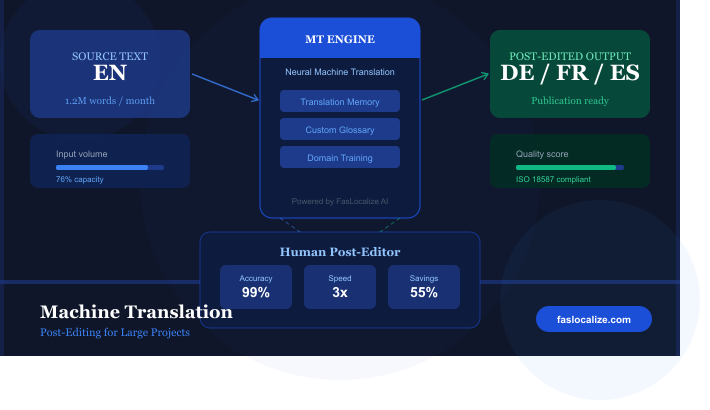
“Machine Translation Post-Editing (MTPE) is a translation workflow where professional human translators review, correct, and refine machine-generated translations. This process leverages AI’s speed with human precision, focusing on improving accuracy, fluency, and consistency rather than translating from scratch. MTPE significantly reduces time and cost compared to traditional human translation, making it ideal for large-volume projects requiring quality.”
In today’s fast-paced global market, businesses are under constant pressure to deliver multilingual content quickly, accurately, and at scale. Machine Translation Post-Editing (MTPE) has emerged as one of the most effective strategies for handling large-volume translation projects without sacrificing quality. At FasLocalize, we combine the speed of AI-powered machine translation with the precision of expert human post-editors to deliver results that meet the highest professional standards.
Whether you are localizing software, legal documents, e-commerce product catalogs, or marketing materials, understanding the benefits of machine translation post-editing can transform how your business approaches multilingual communication.
What is Machine Translation Post-Editing (MTPE)?
Machine Translation Post-Editing (MTPE) is a translation workflow in which machine-generated translations are reviewed, corrected, and refined by professional human translators. Rather than translating from scratch, post-editors focus on improving accuracy, fluency, and consistency, significantly reducing the time and cost compared to traditional human translation.
MTPE typically falls into two categories:
- Light Post-Editing (LPE): Minimal corrections for fast turnaround, suitable for internal communications or content where minor imperfections are acceptable.
- Full Post-Editing (FPE): Comprehensive review to ensure the final output meets the quality standards of a professionally translated document, ideal for client-facing, legal, or technical content.
Key Benefits of Machine Translation Post-Editing for Large Projects
1. Dramatically Faster Turnaround Times
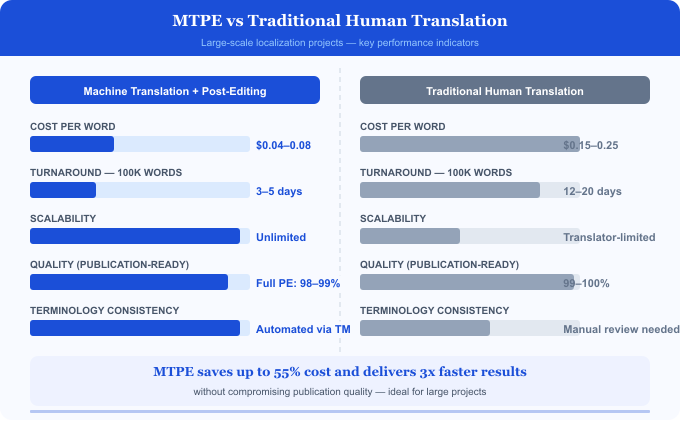
For large projects involving thousands, or even millions, of words, traditional human translation can take weeks or months. Machine translation post-editing dramatically accelerates this timeline. MT engines can process entire documents in seconds, and skilled post-editors can review and refine content significantly faster than translating from scratch.
FasLocalize’s MTPE workflow allows clients to scale translation output while maintaining strict delivery schedules, a critical advantage for product launches, regulatory filings, and time-sensitive marketing campaigns.
2. Significant Cost Savings at Scale
One of the most compelling advantages of machine translation post-editing for large projects is its cost-effectiveness. Because MT engines handle the bulk of the translation work, post-editors spend less time per word, and this translates directly into lower per-word rates.
Studies across the localization industry consistently show that MTPE can reduce translation costs by 30% to 60% compared to fully human translation, depending on the language pair, content type, and MT engine quality. For enterprises managing large localization budgets, these savings are transformative.
3. Consistent Terminology Across Large Volumes
Maintaining terminology consistency across hundreds of thousands of words is one of the biggest challenges in large translation projects. Machine translation engines trained with Translation Memories (TMs) and customized glossaries ensure that specific terms, brand names, and product descriptions are used consistently throughout the entire project.
4. Scalability Without Compromise
Traditional translation teams face a ceiling: adding more content means adding more translators, which increases coordination complexity and costs. MTPE removes this ceiling. With machine translation handling initial drafts, projects can scale from 10,000 words to 10 million words with the same streamlined workflow.
This scalability makes MTPE the preferred approach for:
- E-commerce platforms with large product catalogs
- Software companies are releasing global product updates
- Legal or regulatory bodies requiring multilingual compliance documentation
- Media and entertainment companies are localizing large content libraries
5. Improved Translator Productivity and Focus
Post-editing allows professional translators to focus their expertise on what matters most: ensuring accuracy, cultural appropriateness, and stylistic quality. Rather than spending time on routine translation tasks, they can focus on nuanced, complex segments that genuinely require human judgment.
This not only improves job satisfaction for translators but consistently leads to higher-quality final deliverables.
6. Quality Control and Human Oversight
Unlike fully automated machine translation, MTPE maintains a critical human quality control layer. Every segment reviewed by a post-editor ensures that errors, whether grammatical, contextual, or cultural, are identified and corrected before delivery.
When is MTPE the Right Choice for Your Project?
Machine translation post-editing delivers maximum value when:
✓ Your project exceeds 50,000 words
✓ Tight deadlines require faster delivery without quality compromise
✓ You need to localize into multiple language pairs simultaneously
✓ The content domain is well-supported by available MT engines (technical, legal, medical, software)
✓ Your budget requires cost optimization without moving to fully automated translation
MTPE may be less suitable for highly creative content, such as literary translations, advertising taglines, or content requiring significant cultural adaptation, where the MT baseline may require more effort than translating from scratch.
How FasLocalize Delivers Superior MTPE Results
FasLocalize’s machine translation post-editing service is built on three pillars:
Expert Post-Editors: Our linguists are native speakers with domain expertise, trained specifically for post-editing workflows.
Optimized MT Engines: We select and fine-tune MT engines for your content type and language pair, leveraging proprietary Translation Memories to improve baseline quality.
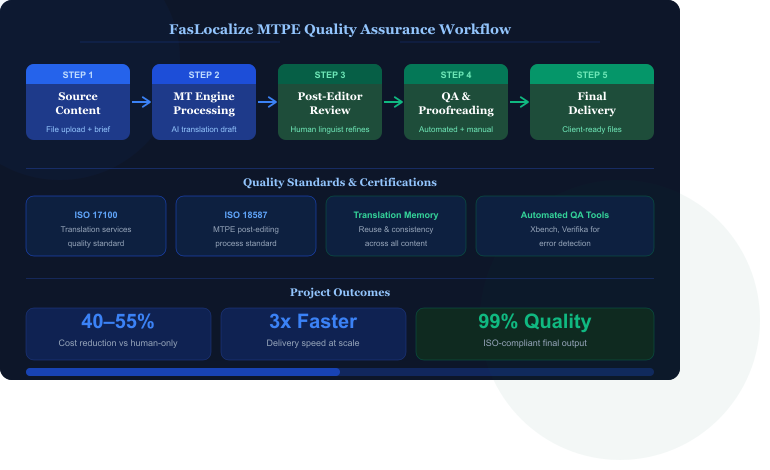
Rigorous QA Process: Every project undergoes automated error checking, human review, and final sign-off before delivery.
Our clients across industries, including technology, legal, healthcare, and e-commerce, consistently report 40-50% faster delivery times and cost reductions of up to 55% when switching to FasLocalize’s MTPE workflow.
Frequently Asked Questions (FAQ)
What is the difference between machine translation and MTPE?
Machine translation (MT) is a fully automated translation produced by AI engines without any human input. MTPE adds a professional human post-editing layer to review, correct, and refine the MT output, ensuring publication-quality accuracy and fluency.
How much does machine translation post-editing cost?
MTPE pricing varies depending on the language pair, content type, level of post-editing required (light vs. full), and project volume. At FasLocalize, we offer competitive per-word rates that are typically 30-55% lower than standard human translation rates. Contact us for a custom quote.
Which industries benefit most from MTPE?
Industries with high-volume, structured content see the greatest MTPE benefits: technology and software, legal and compliance, e-commerce, life sciences, manufacturing, and financial services. FasLocalize specializes in all of these verticals.
Is MTPE suitable for all language pairs?
MT engine quality varies by language pair. High-resource language pairs (such as English to Spanish, French, German, or Chinese) generally produce higher-quality MT output, reducing post-editing effort. FasLocalize evaluates MT quality before every project to ensure optimal results.
Conclusion
Machine translation post-editing is no longer just an option for large-scale localization, it has become a strategic necessity for organizations that need to communicate globally at speed and scale. By combining the power of modern MT engines with expert human oversight, MTPE delivers the ideal balance of speed, quality, and cost efficiency.
Related Articles
Ready to get started?
Tell us about your fas localize services project and get a fast, accurate quote from FAS Localize, usually within one business day.
Get a Free Quote →