In today’s global marketplace, businesses, law firms, government agencies, and individuals frequently need legal translation services to communicate across languages and jurisdictions. From contracts and court documents to compliance reports and intellectual property filings, accurate translations are essential to avoid misunderstandings and legal complications.
Unlike general translation, legal translation requires a deep understanding of legal terminology, regional regulations, and cultural nuances. A single mistranslated clause can result in disputes, financial losses, or compliance issues. This is why organizations rely on professional, certified, and localization services to ensure accuracy and consistency.
What Are Legal Translation Services?
Legal translation services involve translating legal documents while preserving their original meaning, intent, and legal validity. These services require expertise in both language and law to ensure that translated documents remain accurate and compliant.
Common documents requiring legal translation include:
- Contracts and agreements
- Court documents
- Immigration paperwork
- Patents and intellectual property documents
- Corporate policies
- Compliance reports
- Employment contracts
- Terms and conditions
- Legal certificates
Professional translation services help organizations operate confidently across international markets while minimizing legal risks.
Why Legal Translation Services Matter for Global Businesses
As businesses expand internationally, they encounter different legal systems, languages, and regulatory requirements. Accurate legal translations help organizations:
- Maintain regulatory compliance
- Protect intellectual property
- Reduce legal risks
- Improve international communication
- Facilitate cross-border business transactions
- Build trust with global stakeholders
When combined with website localizationand translationservices, legal translations create a strong foundation for international growth.
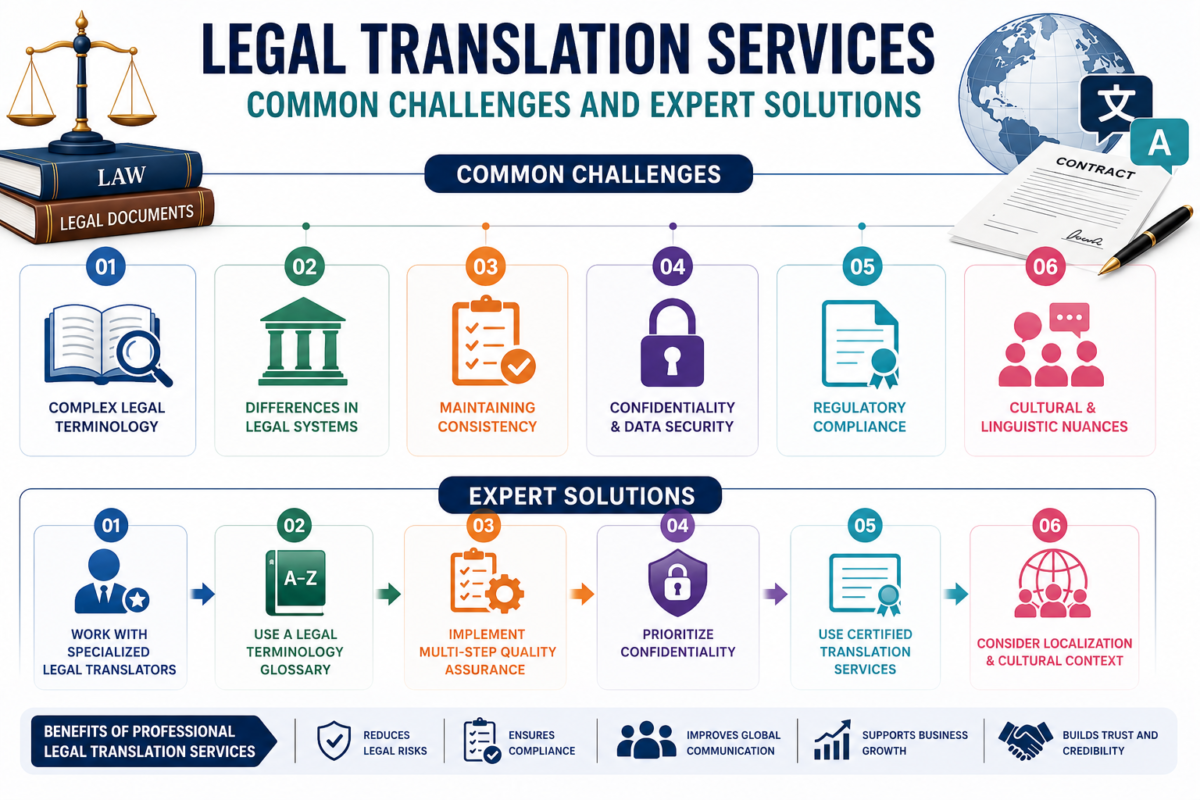
Common Challenges in Legal Translation Services
1. Complex Legal Terminology
Legal documents contain highly specialized language that may not have direct equivalents in another language. Legal concepts often differ between countries, making accurate translation challenging.
Solution
Work with experienced legal translators who understand both the source and target legal systems. Professional linguists can accurately interpret legal terminology while maintaining the document’s intended meaning.
2. Differences Between Legal Systems
A legal concept recognized in one country may not exist in another. Translators must understand how laws differ across jurisdictions.
Solution
Partner with providers offering certified translation services and legal expertise. They can adapt content appropriately while preserving legal accuracy.
3. Maintaining Consistency Across Documents
Large legal projects often contain recurring terms, clauses, and references. Inconsistent translations can create confusion and increase legal risks.
Solution
Use translation memory tools, approved terminology databases, and rigorous quality assurance processes to maintain consistency across all documents.
4. Confidentiality and Data Security
Legal documents frequently contain sensitive information, including contracts, financial records, and intellectual property data.
Solution
Choose a provider that follows strict confidentiality protocols, secure file-sharing methods, and data protection standards.
5. Regulatory Compliance Requirements
Many legal documents must meet specific formatting, certification, or notarization standards before they can be accepted by government agencies or courts.
Solution
Professional legal translation services ensure compliance with local regulations and certification requirements.
6. Cultural and Linguistic Nuances
Language variations and cultural differences can significantly impact how legal content is interpreted.
Solution
Native-speaking translators with legal expertise can localize content appropriately while preserving legal intent.

Best Practices for Accurate Legal Translation
Work with Specialized Legal Translators
Legal translation requires expertise beyond language proficiency. Always choose translators with legal experience and subject-matter knowledge.
Create a Legal Terminology Glossary
A centralized glossary helps maintain consistency across contracts, policies, and other legal documents.
Implement Multi-Step Quality Assurance
An effective quality assurance process includes:
- Initial translation
- Legal review
- Linguistic editing
- Proofreading
- Final quality check
Prioritize Confidentiality
Ensure your translation provider follows strict security measures to protect sensitive information.
Request Certified Translation Services
For official documents, certified translations may be required by courts, immigration authorities, and government institutions.
How Legal Translation Services Support International Growth
Global expansion requires more than simple translation. Businesses need accurate communication that aligns with local regulations and cultural expectations.
By combining legal translation services, multilingual translation services, and website localization services, organizations can:
- Enter new markets confidently
- Improve international customer relationships
- Comply with local laws
- Strengthen global brand reputation
- Support multilingual business operations
Businesses that invest in translation and localization services are better positioned to compete in international markets and avoid costly legal misunderstandings.
Why Choose FAS Localize?
At FAS Localize, we provide professional legal translation services, certified translation services, and localization services tailored to global businesses.
Our solutions include:
- Legal document translation
- Contract translation
- Immigration document translation
- Corporate compliance translation
- Intellectual property translation
- Multilingual localization support
With a focus on accuracy, confidentiality, and quality, we help organizations communicate effectively across borders while maintaining legal compliance.
Frequently Asked Questions
What are legal translation services?
Legal translation services involve translating legal documents such as contracts, court records, patents, and compliance documents while preserving their legal meaning and validity.
Why are certified translation services important?
Certified translation services ensure that translated documents meet official requirements and are accepted by courts, government agencies, and regulatory bodies.
What documents commonly require legal translation?
Contracts, patents, immigration documents, court records, compliance reports, employment agreements, and legal certificates often require professional legal translation.
How do professional translation services ensure accuracy?
Professional translation services use legal experts, native-language linguists, terminology management systems, and quality assurance processes to maintain accuracy.
How can legal translation services help international businesses?
Legal translation services help businesses comply with regulations, manage cross-border contracts, protect intellectual property, and communicate effectively with global stakeholders.
Conclusion
Accurate legal translation services are essential for organizations operating across international markets. From navigating complex legal terminology to ensuring regulatory compliance, professional translation providers help businesses overcome language barriers and reduce legal risks.
Whether you need certified translation services, document translation services, or comprehensive translation and localization services, partnering with an experienced provider ensures accuracy, consistency, and confidence in every legal document.
Ready to expand globally with trusted language solutions? Visit FAS Localize to learn more about our legal translation and localization services.
Related Articles
Ready to get started?
Tell us about your translation theory project and get a fast, accurate quote from FAS Localize, usually within one business day.
Get a Free Quote →