Are you planning to take your business global? If yes, you have probably come across two terms — translation vs localization. Many businesses use these words interchangeably, but they are not the same thing. Understanding the difference between translation and localization can save your business time, money, and a lot of confusion.
Imagine spending thousands of dollars on a marketing campaign, only to realize that your content does not resonate with your target audience because of cultural mismatches. This is exactly what happens when businesses confuse translation with localization.
In this detailed guide, we will break down translation vs localization in simple terms, explore their key differences, and help you decide which one your business truly needs to grow globally.
What Is Translation?
Translation is the process of converting text from one language into another while preserving the original meaning. The primary goal of translation is accuracy — making sure the same information is delivered correctly in the target language.
For example, if you have an English product manual and you convert it word-for-word into French, that is translation. It focuses strictly on words and sentences, without making any cultural or contextual adjustments.
Translation is typically used for content where the exact meaning must be preserved, such as legal contracts, medical records, official certificates, and technical documentation.
Types of Translation Services
- Human Translation: Done by professional linguists for high accuracy
- Machine Translation (MT): Automated translation using AI tools
- MTPE (Machine Translation Post-Editing): AI translation refined by human experts
- Certified Translation: Legally recognized translation with official stamps
When Does Your Business Need Translation?
- Legal documents, contracts, and agreements
- Medical reports, prescriptions, and certificates
- Technical manuals and product guides
- Academic papers, research reports, and diplomas
- Financial statements and business reports
Translation is ideal when the accuracy of information is the top priority and cultural context is less important.
What Is Localization?
Localization goes several steps beyond translation. It is the process of adapting your entire content, product, or brand to fit the cultural, social, linguistic, and regional preferences of your target audience. Localization does not just change the language — it changes the entire user experience.
Think of it this way: translation changes the words, but localization changes the feeling. When a product is properly localized, it feels like it was created for that specific market — not just translated from another language.
What Does Localization Include?
- Currency and number formats (e.g., USD vs EUR, 1,000 vs. 1,000)
- Date and time formats (e.g., MM/DD/YYYY vs DD/MM/YYYY)
- Cultural references, idioms, and humor
- Images, colors, symbols, and design elements
- Local laws, regulations, and compliance requirements
- Tone, writing style, and formality level
- Units of measurement (e.g., miles vs kilometers)
For example, a joke that works perfectly in English may fall flat — or even offend — in Japanese. A color that represents happiness in one culture may symbolize mourning in another. Localization ensures your content feels native and natural to your audience, no matter where they are in the world.
When Does Your Business Need Localization?
- Website and mobile app development for international markets
- Marketing campaigns, advertisements, and social media content
- E-commerce stores targeting customers in multiple countries
- Video games, software, and digital products
- E-learning modules and corporate training materials
- Brand messaging and customer communication
Translation vs Localization: Key Differences
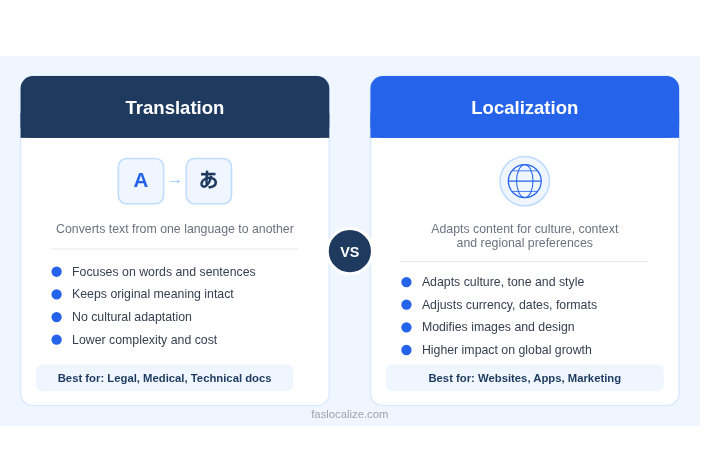
To better understand the difference between translation vs localization, here is a simple comparison:
| Feature | Translation | Localization |
| Focus | Words and text only | Culture, context and experience |
| Scope | Narrow — text level | Culture, context, and experience |
| Goal | Accuracy of meaning | Relatability and engagement |
| Best For | Legal, medical, technical docs | Websites, apps, marketing |
| Considers Culture? | No | Yes, deeply |
| Considers Culture? | Lower | Higher |
| Cost | Lower | Higher but more impactful |
| Output | Translated document | Fully adapted local experience |
Real-World Examples of Translation vs Localization
Sometimes the best way to understand a concept is through real-world examples. Here are some well-known cases that clearly show the difference between translation and localization:
Example 1: McDonald’s
McDonald’s operates in over 100 countries. They do not just translate their menus — they completely localize them. In India, they offer the McAloo Tikki burger instead of beef burgers. In Japan, they serve Teriyaki burgers. This is localization at its finest — adapting the product itself to local tastes and cultural preferences.
Example 2: Netflix
Netflix does not just translate subtitles for its shows. It localizes entire user interfaces, payment methods, content recommendations, and even produces region-specific original content. This deep level of localization is why Netflix has been able to grow rapidly across different countries.
Example 3: A Failed Translation
In the 1970s, Pepsi launched a campaign in China with the slogan ‘Come Alive with the Pepsi Generation.’ However, the direct translation in Chinese roughly meant ‘Pepsi brings your ancestors back from the dead.’ This is a classic example of what happens when businesses rely on translation alone without proper localization.
Which One Does Your Business Actually Need?
Now that you understand the difference between translation and localization, the next step is figuring out which service is right for your specific business needs. The answer depends on your goals, your target audience, and the type of content you are working with.
Choose Translation if:
- You need to convert official documents, contracts, or certificates
- Your content is technical and does not require cultural adaptation
- You are working with internal business reports or data
- Your budget is limited, and accuracy is the top priority
Choose Localization if:
- You are launching a product or service in a new international market
- You want your website or app to feel native to local users
- You are running marketing campaigns targeting foreign audiences
- You want to build long-term trust with international customers
- You are developing a video game, e-learning course, or digital product
In most cases, businesses that are expanding globally need both translation and localization to work together. A well-translated website that ignores local culture will still fail to connect with its audience. The best approach is to combine accurate translation with thoughtful cultural localization for maximum impact.
Benefits of Professional Localization for Your Business
Investing in professional localization services can deliver significant benefits for businesses of all sizes. Here is why localization should be a priority for any company looking to expand internationally:
- Higher Customer Trust: Customers are more likely to buy from a brand that speaks their language and understands their culture.
- Better User Experience: A localized app or website feels intuitive and natural for local users, reducing bounce rates.
- Increased Revenue: Studies show that customers are far more likely to purchase in their native language.
- Stronger Brand Image: A properly localized brand appears professional, credible, and culturally aware.
- Competitive Advantage: Businesses that localize effectively stand out from competitors who rely only on basic translation.
- Improved SEO Rankings: Localized content ranks better in local search engines, driving more organic traffic from target markets.
How FAS Localize Can Help Your Business Go Global
At FAS Localize, we specialize in providing expert translation and localization services that are fast, accurate, and secure. Whether you are a startup looking to enter your first international market or an established enterprise managing multilingual content at scale, we have the expertise and resources to support your global growth.
Our team of certified linguists and native-speaking experts ensures that every project — from legal document translation to full website localization — is delivered with the highest level of quality and precision.
Our Core Services
- Professional Human Translation for documents, legal, and technical content
- Website and App Localization for global digital presence
- MTPE (Machine Translation Post-Editing) for fast and cost-effective results
- SEO Content Creation optimized for local search engines
- Voiceover and Audio Localization for videos and multimedia
- Software and QA Testing across multiple languages and regions
Why Businesses Trust FAS Localize
- 99% accuracy rate with certified linguists and advanced QA tools
- 95% of projects delivered ahead of schedule
- Documents under 10,000 words completed within 24 hours
- 100% compliance with data security standards and NDAs
- Native speakers ensure culturally accurate and natural output
- Competitive pricing with customized packages for every business size
Frequently Asked Questions (FAQs)
Is localization more expensive than translation?
Yes, localization typically costs more than translation because it involves a broader scope of work — including cultural research, design adaptation, and functional testing. However, the return on investment from a well-localized product is significantly higher, especially in competitive international markets.
Can I use machine translation instead of human translation?
Machine translation (MT) has improved significantly with AI advancements, but it still lacks the cultural nuance and contextual understanding that human translators provide. For important content, we recommend MTPE — machine translation combined with professional human post-editing — to get the best of both speed and quality.
How long does localization take?
The timeline depends on the size and complexity of your project. At FAS Localize, we can complete documents under 10,000 words within 24 hours. Larger projects such as full website or app localization may take several days to weeks, depending on the number of languages and the scope of adaptation required.
Do I need localization if I already have a translated website?
Yes, in most cases. Translation alone ensures your text is readable in another language, but it does not guarantee that your website will feel natural or trustworthy to local users. Localization takes care of cultural nuances, local SEO, regional formats, and user experience — all of which are critical for international success.
Final Thoughts
The debate of translation vs localization is not about which is better — it is about which is right for your specific need. For official documents and technical content, accurate translation is the solution. But if you want your brand to truly resonate with a global audience, speak to their hearts, and drive real business results, professional localization is absolutely essential.
The world’s most successful global brands — from Netflix to McDonald’s — invest heavily in localization because they understand that people connect more deeply with content that feels made for them, not just translated for them.