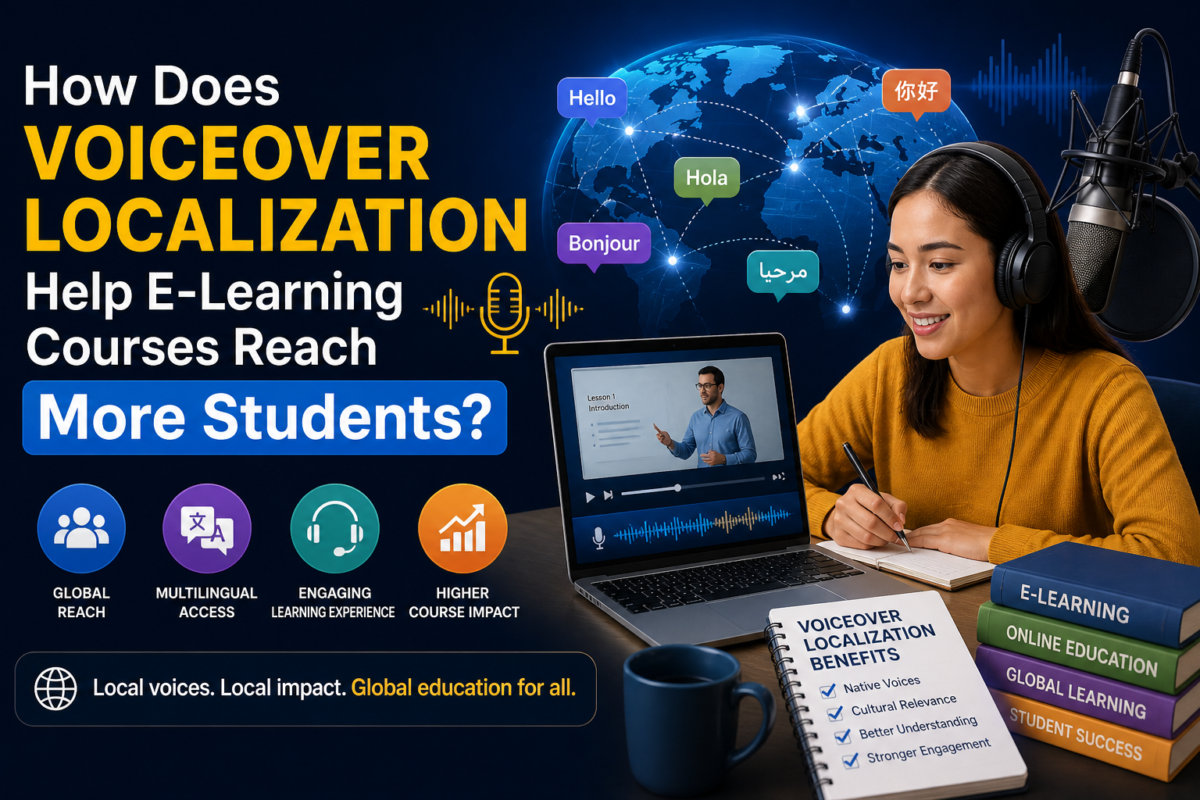
The global e-learning market is growing at an extraordinary pace. Online education platforms, corporate training programs, and academic institutions are all racing to reach learners beyond their home markets — and language has emerged as the single most critical barrier standing in their way.
Subtitles and text translations help, but they are not enough. When learners have to read subtitles while simultaneously trying to absorb complex course content, their cognitive load increases dramatically — and learning outcomes suffer. The solution that is transforming global e-learning is voiceover localization for e-learning: the process of replacing original course audio with professionally recorded native-language narration that allows learners to focus entirely on what they are learning. In this comprehensive guide, we will explore exactly how voiceover localization helps e-learning courses reach more students, improve learning outcomes, and build the kind of global educational impact that Common sense Advisory research consistently confirms is only possible when learners receive content in their native language.
The Global E-Learning Opportunity and the Language Barrier
Online education has fundamentally changed how people learn. Whether it is a software skills course on an online platform, a corporate compliance training program, or a university certificate course offered online, e-learning has made high-quality education accessible to people around the world regardless of geography.
But geography is not the only barrier that stands between e-learning providers and a truly global student base. Language is equally powerful — and far more frequently underestimated.
The reality is that the vast majority of the world’s learners do not speak English as their native language. For e-learning platforms and corporate training providers that develop content in English and rely on subtitles or text translation to reach international audiences, significant learning effectiveness is being sacrificed at every step.
- Learners processing content in a non-native language consistently score lower on comprehension assessments than those learning in their mother tongue
- Course completion rates are significantly lower for non-native language learners compared to those with localized audio content
- Cognitive load theory confirms that dual-channel processing — reading subtitles while processing audio — reduces the mental bandwidth available for actual learning
- Learner satisfaction and willingness to recommend courses drops significantly when audio content is not available in the learner’s native language
What Is Voiceover Localization for E-Learning?
Voiceover localization for e-learning is the process of replacing the original narration in an e-learning course with professionally recorded native-language audio that is culturally adapted, timing-synchronized, and pedagogically appropriate for the target learner audience.
Unlike simple translation, voiceover localization for e-learning involves multiple specialized steps:
- Script translation and adaptation: The course script is translated by a native-speaking specialist who adapts terminology, examples, and cultural references for the target market while preserving the educational intent of each lesson.
- Educational review: A subject matter expert reviews the translated script to ensure that technical terminology, learning objectives, and assessment language are accurately and appropriately rendered in the target language.
- Voice talent selection: A professional native-speaking voice artist is selected whose vocal style, energy, and pace match the course’s instructional design and target learner demographic.
- Professional recording: The localized script is recorded in a professional studio environment, with multiple takes to ensure optimal delivery for each course section.
- Audio synchronization: Audio engineers synchronize the localized narration with the course’s visual elements, animations, and interactive components.
- Quality assurance: A native-speaking QA reviewer checks the final localized audio against the original course to verify accuracy, timing, and educational effectiveness.
6 Key Ways Voiceover Localization Helps E-Learning Reach More Students
1. Removes the Single Biggest Barrier to Global Course Access
Language is the primary reason why qualified, motivated learners in non-English-speaking markets do not enroll in or complete online courses that would genuinely benefit them. When a course is available in the learner’s native language — with natural, professionally voiced narration rather than subtitles or robotic text-to-speech — the language barrier disappears entirely.
For e-learning providers, this translates directly into a dramatically larger addressable market. A corporate training course localized into Vietnamese, for example, becomes accessible to Vietnam’s entire workforce rather than only the English-proficient segment — potentially multiplying the potential learner base many times over.
2. Dramatically Improves Learning Outcomes and Knowledge Retention
The cognitive science behind this is clear and well-established: learners absorb, process, and retain information significantly more effectively when it is delivered in their native language. When learners are not struggling to process a foreign language, all of their cognitive capacity is available for the actual learning task — understanding concepts, applying knowledge, and building skills.
Studies consistently show that e-learning courses with native-language voiceover achieve measurably better outcomes than courses relying on subtitles, including higher scores on knowledge assessments, better skill transfer to workplace tasks, and stronger long-term retention of course content.
3. Increases Course Completion Rates Significantly
Course completion rates are one of the most critical metrics for e-learning providers, and one of the most reliably improved by voiceover localization. When learners are engaged with content that they can fully and effortlessly understand, they are far more likely to continue to the end of the course rather than abandoning it midway through.
For corporate training programs where completion is mandatory for compliance purposes, voiceover localization reduces the frustration and time burden that foreign-language content places on non-native speakers — improving not just completion rates but also learner attitude toward the training program as a whole.
4. Builds Learner Confidence and Engagement
Learning is an inherently personal experience, and the language in which content is delivered has a profound impact on how confident and engaged learners feel. When a course speaks to learners in their own language — with a voice that sounds like someone from their own cultural community — it creates an immediate sense of inclusion and belonging.
This sense of inclusion is especially important for learners from communities where access to high-quality education has historically been limited by language. Voiceover localization signals that the course was designed for them — not adapted as an afterthought — and this signal of respect and inclusion directly increases learner motivation and engagement.
5. Enables Compliance and Regulatory Training Across Global Workforces
For multinational corporations operating across multiple countries, delivering mandatory compliance training — covering topics such as workplace safety, data privacy, anti-bribery, and ethical conduct — in a language that employees can fully understand is not just a best practice, it is increasingly a legal and regulatory requirement. In markets like Vietnam, workplace training content must be accessible and comprehensible to all employees regardless of their English proficiency, which effectively mandates native-language audio content for compliance training programs.
Voiceover localization ensures that compliance training content is not just technically available in multiple languages but genuinely understood by every learner — which is the only outcome that actually protects both the learner and the organization.
6. Supports Scalable Global Expansion for E-Learning Platforms
For e-learning platforms looking to expand into new markets, voiceover localization is the most scalable and cost-effective approach to building a genuinely global course catalog. By localizing existing high-quality course content into additional languages rather than developing new content from scratch for each market, platforms can rapidly expand their offering without proportional increases in content development cost.
A systematic voiceover localization workflow — supported by professional language service providers like FAS Localize — allows e-learning platforms to enter new markets quickly, with localized content that meets the quality expectations of learners in each target market.
Voiceover Localization for E-Learning in Vietnam
Vietnam represents one of the most compelling opportunities for e-learning providers investing in voiceover localization in 2026. With a population of over 98 million, a strong cultural emphasis on education and self-improvement, and a rapidly growing digital economy Vietnam has one of the most engaged and rapidly growing online learner populations in Southeast Asia.
However, Vietnamese is a tonal language with six distinct tones where a single incorrect tone mark changes the meaning of a word entirely. Three major regional dialects — Northern, Central, and Southern Vietnamese — each have distinct pronunciation differences that significantly affect whether content sounds natural and authoritative to learners in different parts of the country.
For e-learning providers targeting Vietnamese learners, these linguistic complexities make professional voiceover localization with certified native Vietnamese voice talent absolutely essential. Amateur or machine-generated Vietnamese audio in educational content is immediately recognizable to Vietnamese learners and dramatically reduces the credibility and effectiveness of the course.
Key considerations for Vietnamese e-learning voiceover localization:
- Northern Vietnamese (Hanoi standard) is appropriate for formal academic and professional training content
- Southern Vietnamese (Ho Chi Minh City) is often more appropriate for consumer-facing and informal learning platforms
- Voice tone and authority level must match the course subject matter and instructor positioning
- Technical and academic terminology must be verified by subject matter experts with Vietnamese language expertise
- Cultural examples and case studies should be adapted to Vietnamese business and social contexts for maximum relevance
E-Learning Sectors That Benefit Most From Voiceover Localization
Corporate Learning and Development
Multinational companies with Vietnamese operations, sales teams, or channel partners use voiceover localization to ensure that onboarding programs, product training, leadership development, and compliance courses are fully effective for their Vietnamese-speaking employees. Native-language training content consistently produces better knowledge transfer and skill application outcomes compared to English-language or subtitled alternatives.
Academic and Certification Courses
Online universities and professional certification providers use voiceover localization to open their courses to learners who are qualified and motivated but deterred by English-language content. Localized voiceover allows these providers to expand their student base and revenue without developing entirely new course content.
Healthcare and Safety Training
Healthcare worker training, patient education content, and workplace safety programs require the highest possible level of learner comprehension. In healthcare and safety contexts, language barriers are not just a learning effectiveness issue — they are a patient safety and workplace safety issue. Voiceover localization in native languages is essential for these high-stakes training environments.
Technology and Software Training
Technology companies offering product certification programs, software training courses, and developer education use voiceover localization to support their Vietnamese customers and partners. When Vietnamese technology professionals can learn in their native language, adoption rates improve, support costs decrease, and customer satisfaction scores rise.
How FAS Localize Delivers E-Learning Voiceover Localization
At FAS Localize, we have built a comprehensive e-learning voiceover localization service specifically designed to meet the unique requirements of educational content providers. Our end-to-end workflow covers every stage from script translation to final audio delivery, with specialized expertise in Vietnamese and Southeast Asian language markets.
Our e-learning voiceover localization services include:
- Course script translation and educational adaptation by native-speaking specialist translators
- Subject matter terminology review for technical, medical, legal, and professional course content
- Professional native Vietnamese voice talent selection covering Northern and Southern dialects
- Studio-quality recording with broadcast-ready audio output
- Timing synchronization with course animations, slides, and interactive elements
- SCORM and LMS-compatible audio file delivery in all required formats
- Rigorous quality assurance by native-speaking educational content reviewers
Why E-Learning Providers Choose FAS Localize
✓ Native Vietnamese voice talent covering Northern and Southern dialects
✓ 99% accuracy rate with specialized educational QA process
✓ Cultural adaptation ensuring examples and references resonate with Vietnamese learners
✓ SCORM, xAPI, and LMS-compatible delivery formats
✓ 95% of projects delivered ahead of agreed deadlines
✓ Full support for rapid course catalog expansion across multiple Asian languages
✓ 100% data security compliance and NDA protection for proprietary course content
Frequently Asked Questions About E-Learning Voiceover Localization
Is voiceover localization better than subtitles for e-learning?
Yes, for most e-learning content, voiceover localization consistently outperforms subtitles in learning outcomes, completion rates, and learner satisfaction. Subtitles require learners to read while also processing visual course content, creating a dual cognitive load that reduces learning effectiveness. Native-language voiceover eliminates this cognitive burden, allowing learners to devote full attention to understanding the course content.
How long does it take to localize an e-learning course with voiceover?
Timeline depends on course length and complexity. A standard one-hour e-learning module typically takes 5-7 business days for complete voiceover localization including script translation, recording, synchronization, and quality assurance. For larger course catalogs, FAS Localize can run multiple courses in parallel to meet faster rollout timelines. Contact us for a customized timeline based on your specific project scope.
What audio formats does FAS Localize deliver for e-learning platforms?
FAS Localize delivers localized e-learning audio in all major formats including MP3, WAV, and OGG, as well as SCORM and xAPI-compatible packages ready for direct upload to your LMS or e-learning platform. We work with all major platforms including Moodle, Canvas, Cornerstone, SAP SuccessFactors, and custom LMS environments.
Why is Vietnamese e-learning voiceover localization more complex than other languages?
Vietnamese voiceover localization requires specialized expertise because Vietnamese is a tonal language with six distinct tones, three major regional dialects with significant pronunciation differences, and a complex social register system that affects appropriate formality and tone for educational content. Raw machine-generated Vietnamese audio immediately sounds unnatural and unprofessional to native Vietnamese learners. FAS Localize’s dedicated Vietnamese voice talent and linguistic quality assurance process ensures that all Vietnamese e-learning audio meets the highest standards of naturalness and educational effectiveness.
Final Thoughts
Voiceover localization is the most powerful tool available to e-learning providers who want to genuinely reach, engage, and educate learners across language barriers. It is the difference between a course that is technically available in multiple languages and a course that actually delivers learning outcomes for learners in every language it serves.
For e-learning providers targeting the Vietnamese market and broader Southeast Asian learner populations, investing in professional, culturally-aware voiceover localization with certified native voice talent is not just a competitive advantage — it is the foundation of genuine educational impact across the language and cultural diversity of the global learner community.
Ready to expand your e-learning reach with professional voiceover localization? Contact FAS Localize today and let our e-learning localization specialists help your courses reach every learner in their own language.